
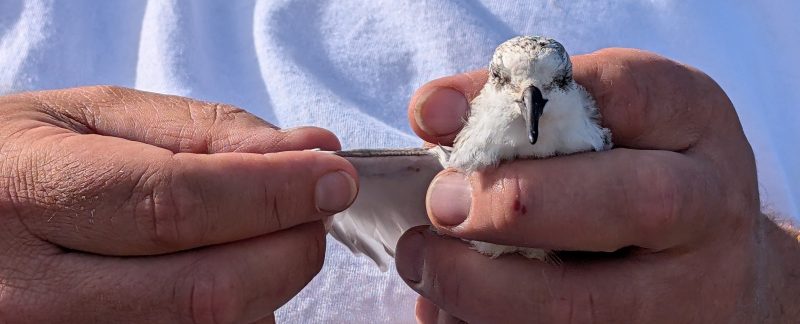
Saturday 6 September
Team members began to arrive on Friday evening to recce various options for cannon-net catching and resighting on Saturday morning. The previous autumn passage week and this week were relatively limited in terms of very high tides which could push birds onto fields for catching (this week was the marginally better one of the two) or beaches in high numbers. Only Tuesday, Wednesday and Thursday were very high tides.
An early start on Saturday was in store for Claudia, Holly, Sabine, Natasha, Liam and Isla to observe the three main Wash east-shore beaches (Snettisham, Heacham, Heacham North North) at high tide. They were joined for resighting by Richard with a mixture of Wash Curlew, headstarted Curlew, Bar-tailed Godwit and Knot seen. As the team assembled in the afternoon, a small team undertook a resighting trip on the rising and high tide on the east shore. This year has been effective for re-encounters of Bar-tailed Godwit in comparison to recent years, with the flock favouring a pre-roost south of the Sailing Club at Snettisham at a favourable distance for flag reading. Curlew had been surprisingly less frequently encountered by the team this autumn passage to date, hence these data were valuable. An hour observing birds moving up the intertidal on Snettisham beach by Rob, Liam, Holly and Natasha was followed by the Bar-tailed Godwit pre-roost to yield a very respectable 140+ encounters for the day.
Additional rising tide, evening cannon-net capture options were explored in the evening, with small numbers of Sanderling encountered at Heacham South and small numbers of Turnstone at Heacham North North.
Sunday 7 September
A cunning plan to recce the entire Wash with the whole team was instigated on the Saturday evening, which necessitated a 04:30 hrs start for the Lincolnshire team of Steve & Phil (Horseshoe Lagoon) and Rob & Holly (Freiston shore). The catching options at the horseshoe were limited, but continued monitoring of the site was planned through the week with the expectation that more water on a higher tide would make this roost more favourable. Initial observations were of 50 Oystercatchers and 300 Redshank which were disturbed by Peregrine and Marsh Harrier before clearing the roost 30 minutes in advance of high tide. A potential high tide catch option for Curlew at Freiston identified in July was investigated, but the tide height at 7.38 m (24.2’) was not sufficient to cover the saltmarsh and push birds onto a field currently occupied by sheep. Around 600 Redshank were using the newly created lagoon at Freiston (one flag read) along with around 200 Black-tailed Godwit (one colour-ring combination read) and around 40 Greenshank. The total wader flock size when Oystercatcher, Ringed Plover and Dunlin were included totalled around 2,000. A Dutch-colour-marked Spoonbill added variety to the wader spectacle.
Richard was tasked with his perennial quest of a successful cannon-net catch at Gedney: here the intertidal pool had not yet filled but several thousand waders were in the vicinity. All boded well for a catch attempt the following day. A walk of the Ken Hill inner seawall by Liam failed to identify Curlew flocks using roost locations in the near vicinity. It seemed that the bulk of Curlew in the area were on the Wolferton Saltmarshes. Snettisham, Heacham and Heacham NN beaches were viewed again, without significant numbers of Sanderling or Turnstone identified. Hunstanton had a couple of thousand Oystercatchers roosting on a sandbank, however no catchable birds were identified. Good numbers of Black-tailed Godwit (930) were seen in Snettisham pits along with 300 Knot and 40 Turnstone at high tide.
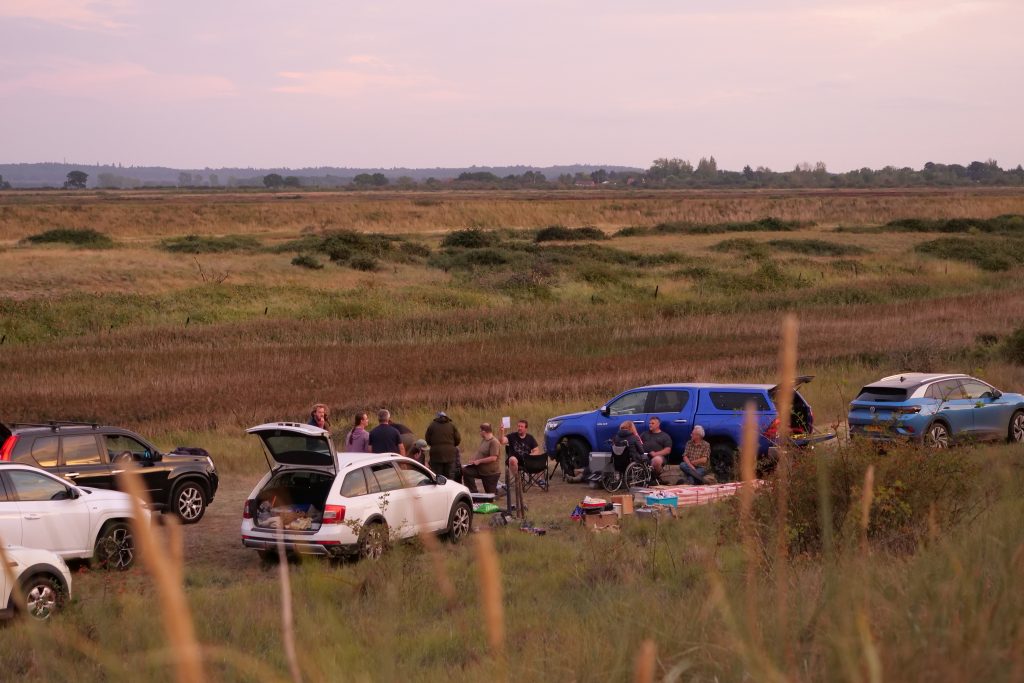
An evening catch with two teams was planned, a catch on Heacham NN for Turnstone was felt to be useful in order to increase the proportion of colour-ringed Turnstone in our longstanding project aiming to evaluate survival in this declining wader species. This project is approaching it’s 30th birthday and over 5,000 sightings have been recorded. A single net was deployed in front of the usual house with a flock of 26 Turnstone and one Ringed Plover twinkled into the decoys by Richard. A dry catch was taken with the processing and colour-marking combined with a small catch at the adjacent Heacham South Beach of Sanderling. We were able to increase the number of marked birds in our study (12) by marking adults in wing moult, who at this time of year are likely to remain on The Wash for winter as opposed to moving through The Wash to winter elsewhere. The evening saw the team plan yet more recces the following morning given the relative paucity of catch options.
Heacham NN catch totals
| Species | New | Retrap | Total |
| Turnstone | 15 | 11 | 26 |
| Ringed Plover | 0 | 1 | 1 |
| Total | 15 | 12 | 27 |
Heacham South catch totals
| Species | New | Retrap | Total |
| Sanderling | 3 | 0 | 3 |
| Total | 3 | 0 | 3 |
Monday 8 September
The tide at Wolferton Saltmarsh was deemed to be a “Goldilocks” opportunity for resighting large numbers of Curlew. At 7.8 metres, this tide was not high enough to flood the saltmarsh and push birds onto fields, but high enough to concentrate birds into a bay for easy colour-mark reading from a hide. A three-person hide was placed on the saltmarsh just before dawn, with early morning wildfowling prevented occupation of further bays. Observation of the hide was undertaken from the RSPB reserve but, despite the large flock of over 1,000 Curlew and several thousand Oystercatcher, Bar-tailed Godwit and Knot present, it was clear that the position of the hide could have been better.
The initial hide placement was conservative and approximately 25 metres too far away from the edge of the saltmarsh, due to fears that the tide would flood the saltmarsh (which were ultimately unfounded). This was remedied by Liam, Claudia and Sabine walking the hide with kit carefully closer to the edge of the saltmarsh without disturbing the birds. By then the birds were pushed close to the edge of the saltmarsh rendering ring reading too difficult: unfortunately, this meant the window of reading colour flags as birds came in was missed.
The best period of resighting in this three and a half hour session was on the falling tide, where 20 sightings were made by the hide team, and the shore-based team of Duncan and Rob managed a further 30. The hide was taken down at 09:30 hrs, 2 hours and 20 minutes after high tide. Given a single observer session two weeks earlier yielded 65 sightings on a 7.6 metre tide, this was felt to be something of a missed opportunity; however, we have now established optimal tide ranges for this group activity, with a suitable tide range where the birds are not roosting too far away or having the saltmarsh flood confirmed (range 7.3 m to 7.8 m, 7.6 m optimal). We hope to repeat this work regularly as it has shown considerable value in re-encountering both rarely encountered WWRG and headstarted Curlew. Whilst these activities were underway, further catch opportunities were being evaluated.
Gedney was viewed again by Richard, Phil and Tim, with the pools filling with water, in preparation for an evening catching attempt. The Horseshoe was once again viewed by Steve and Freya, with the volume and location of waders not deemed suitable for a catch option at present. Freiston similarly had only a single Curlew within the catch field despite the saltmarsh covering.
The team set in the afternoon at Gedney for an evening, rising-tide catch. Despite the team being in place before the tide came in, movement of raptors (not communicated to the catch team) caused the flock to lift with around 25 birds in the catching area. With the missed opportunity of a consolation catch and approaching high tide, the team broke cover and quickly cleared equipment before the saltmarsh covered.
Tuesday 9 September
With a failed attempt the previous evening, yet more observations were undertaken to identify birds on the highest of the week’s tides. Steve identified two promising field sites at Friskney with 1,500 Curlew at one location and 500 at an adjacent site, both inland of the seawall. Richard identified a large southern movement of Bar-tailed Godwit moving towards Frampton Marsh, but nothing substantial roosting on fields.
Phil returned to Gedney with a potential option to return for a catch attempt on Tuesday evening. A similar number were seen as on prior observations, however, given the suitable Curlew options this was not followed up with a catch attempt. At Heacham South the high tide resulted in an assembly of around 1,000 Sanderling pushed high on the tideline. A mixed flock of roughly equally distributed Sanderling and Ringed Plover was encountered by Alex at Snettisham, the flock of 200+ favouring a particular patch of beach. Phil later found an unsettled and flighty group of 150 Curlew at Holbeach adjacent to a gull flock. Harrier disturbance caused around two thirds to head back to the saltmarsh at around 07:20 hrs. A small flock of 17 Greenshank were seen at the regular Holbeach roost by Claudia, but they flew off. David found a flock of 100 Curlew over on the Lincolnshire side (Proctors), all of which were disturbed by large corvids and flew off at 08:30 hrs.
Rob, Michelle and Freya found a flock of 150 Curlew with very occasional Bar-tailed Godwit on a field adjacent to Snettisham RSPB pits, with a further 20 in an adjacent field. Rob R, Holly and Natasha found a flock of around 60 Turnstone with a high proportion colour ringed, including multiple birds from the previous day. These observations are exceedingly useful, as the analysis we undertake on these birds rely on having a first sighting re-encounter to undertake recruitment into survival assessments.
With the prospect of two adjacent Curlew field catches in Lincolnshire, the entire team relocated to Lincolnshire with the exception of Nigel, Jacquie and Rob who stayed to review Norfolk catch options for Thursday.
Wednesday 10 September
Two field locations for Curlew were set on Tuesday afternoon on maize stubble and pea stubble, with both catches manned by the divided team. The Lincolnshire accommodation was vacated at 06:00 hrs to ensure plenty of time to be in place prior to birds coming over the seawall to roost at high tide. A flock of around 500 birds came onto Richard’s field, with two WWRG GPS/GSM tagged birds marked in 2023 seen alongside a female Curlew colour-marked in Wales in October 2021. At one point a catch of 50–70 Curlew was imminent, but this fell to 30–40. The team fired but technical issues resulted in an actual catch size of 14 birds with one retrap. Meanwhile Phil had been more successful with a catch of 48 Curlew (including one juvenile and three retraps) and two Bar-tailed Godwit. One bird was a juvenile, but the other was a large female not in moult destined to travel to Africa: ideal for tagging. The tag was successfully deployed and location information began to be reported back the following day. Despite the missed opportunity to have two samples of around 50 birds, this was a highly valuable catch of moulting Curlew on the western shore of The Wash for the first time in several years.
The weather was noted to be inclement over Wednesday evening with a combination of a predicted band of rain at high tide just at the point of mist-net capture, too high wind speed and high tide close to dusk rendering mist netting non-viable.
Catch 1 West Lincs
| Species | New | Retrap | Total |
| Curlew | 13 | 1 | 14 |
| Total | 13 | 1 | 14 |
Catch 2 West Lincs
| Species | New | Retrap | Total |
| Curlew | 42 | 4 | 46 |
| Black tailed Godwit | 2 | 0 | 2 |
| Total | 44 | 4 | 48 |
Thursday 11 September
The team woke at 05:00 hrs to head to Snettisham for a beach catch of predominantly Sanderling seen the previous evening. Two small-mesh nets were set on the high point of the beach (large-mesh nets were considered given the wind strength, but not used) with the setting finished shortly after the intertidal covered. The tide at 8.2 m pushed birds north to the Snettisham beach location and numbers steadily built towards high tide. The Sanderling flock continued to accumulate numbers towards high tide and was augmented by smaller numbers of Ringed Plover and Dunlin.
Birds came in front of both nets as the tide rose, with around 1,500 birds in front of two nets. One net was selected to fire, and nearly 1,000 birds were caught. Fortunately, the 50:50 predicted rain stayed away during our busy morning of ringing and processing. A sizeable number of retraps were captured (231 Sanderling) with recovery highlights including Sanderling ringed in Spain, Greenland and Norway. The vast majority of birds caught were moulting adults with a small proportion of juveniles. A sample of Ringed Plover were also caught which included a bird originally flagged in Norway. A small number of Dunlin were also captured. The number of retrapped Sanderling would allow estimates of juvenile recruitment into the population alongside survival estimates. Detailed measurements were taken on a sample of new moulting adult birds, retraps and juveniles, with three processing teams deployed. The catch was dealt with quickly with all birds released in time to go back to the feeding areas once they were available.
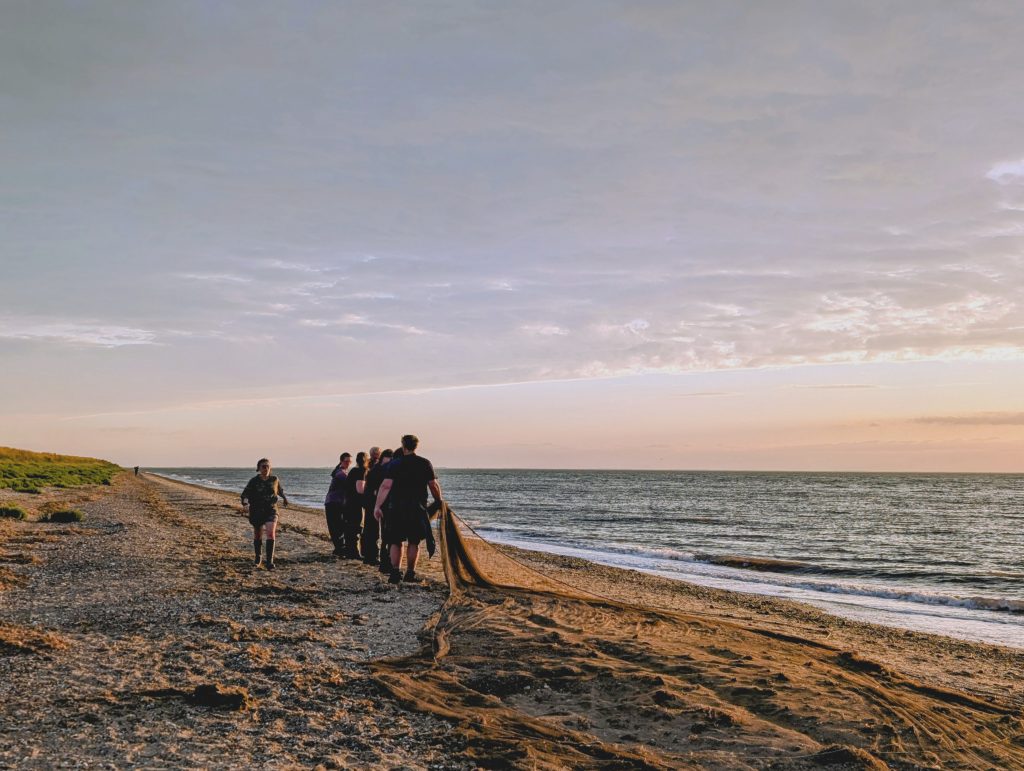
David was dispatched to Heacham beach prior to capture to evaluate the numbers of birds on the alternative roost site at high tide. He found around 200 Sanderling and smaller numbers of Dunlin, Ringed Plover and Oystercatcher.
The team returned to a cooked breakfast provided by Cathy and Sabine, who had been recceing in Lincolnshire. After a successful, busy morning, the evening mist netting was deemed marginal due to high winds and efforts were saved for a morning catch in Lincolnshire aiming for Oystercatcher. The team divided into teams for handling the mountain of data generated for the morning’s activity, sorting out kit and packing for a trip to Lincolnshire. An advance setting team was tasked to move back to the Lincolnshire accommodation in preparation for an early start to set cannon nets on the Horseshoe for Oystercatcher.
Snettisham catch totals
| Species | New | Retrap | Total |
| Ringed Plover | 47 | 5 | 52 |
| Sanderling | 703 | 231 | 934 |
| Dunlin | 11 | 0 | 11 |
| Total | 761 | 236 | 997 |
Friday 12 September
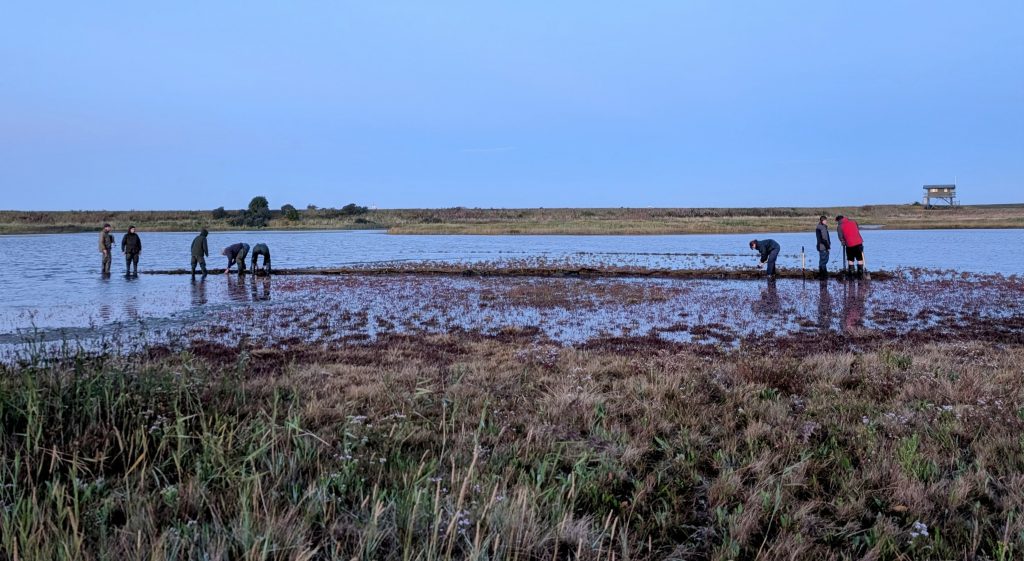
An early start was necessary to ensure the bulk of the net team was under tarpaulin on the Horseshoe Lagoon in preparation for a catch into shallow water. The remainder of the team was present across the lagoon in a hide. There was a degree of raptor disturbance, however two flock nuclei of Dunlin and Oystercatcher eventually landed in the catching area and the seven-cannon net was fired. The lift (requiring the team to keep Oystercatcher and Dunlin separate) was carried out efficiently and a sample of mostly juvenile Dunlin (28) and Oystercatcher (35) was obtained. The relatively small catch allowed checks of our biometric concordance between observers for both wing length and head and bill measurements to be made. The whole team returned to the Norfolk base in preparation for the evening mist-netting activity.
Horseshoe catch totals
| Species | New | Retrap | Total |
| Oystercatcher | 35 | 0 | 35 |
| Dunlin | 28 | 0 | 28 |
| Total | 63 | 0 | 63 |
Two lines of five nets were set on the outer pools at Terrington in anticipation of a potentially large catch given the time of year. The majority of birds were caught on a single round as the birds were pushed onto the marsh by the incoming tide. The large team was occupied by moving the long-legged species (including Curlew, Whimbrel, Bar-tailed and Black-tailed Godwit) off the marsh promptly for swift processing and release. This session was perhaps notable for the variety of species caught (12: Oystercatcher, Grey Plover, Whimbrel, Curlew, Bar-tailed, Black-tailed Godwit, Turnstone, Knot, Ruff, Greenshank, Dunlin, Redshank) rather than substantial sample sizes, with 35 Redshank being the most frequently caught species. Nevertheless, colour-marking allowed three Grey Plover, six Bar-tailed Godwit, seven Black-tailed Godwit, four Knot and one Greenshank to be added to existing colour-mark schemes. The variety of species included several which are not regularly captured in the UK, ensuring that the less-experienced members of the team were able to increase their familiarity with a range of species.
Terrington totals
| Species | New | Retrap | Total |
| Oystercatcher | 4 | 0 | 4 |
| Grey Plover | 3 | 0 | 3 |
| Whimbrel | 3 | 0 | 3 |
| Curlew | 7 | 0 | 7 |
| Bar-tailed Godwit | 6 | 0 | 6 |
| Black-tailed Godwit | 8 | 0 | 8 |
| Turnstone | 8 | 0 | 8 |
| Knot | 3 | 1 | 4 |
| Ruff | 1 | 0 | 1 |
| Dunlin | 9 | 0 | 9 |
| Redshank | 34 | 1 | 35 |
| Greenshank | 1 | 0 | 1 |
| Total | 87 | 2 | 89 |
The following day the team took a leisurely return home after a productive week of fieldwork.
Resighting totals
| Species | WWRG sightings | WWRG individuals | Other sightings | Other individuals |
| Curlew | 61 | 47 | 2 | 2 |
| Bar-tailed Godwit | 110 | 85 | 1 | 1 |
| Black-tailed Godwit | 1 | 1 | 0 | 0 |
| Redshank | 6 | 4 | 0 | 0 |
| Knot | 2 | 2 | 4 | 4 |
| Sanderling | 0 | 0 | 1 | 1 |
| Turnstone | 33 | 19 | 0 | 0 |
| Total | 213 | 158 | 8 | 8 |
Additional sightings of a Little Egret and a Spoonbill ringed in the Netherlands were recorded.
Notable resightings
Resightings by Carole and Bernard from Snettisham pits on 12 September 2025
- Knot – ringed by WWRG on 31 August 2023 at Gedney. No previous sightings.
- Knot – ringed by WWRG on 15 August 2025 at Admiral’s Farm (during the previous field trip)
- Knot – ringed by a team including WWRG members on 17 May 2025 in SW Iceland
- Knot – ringed by NIOZ on 4 November 2021 at Griend, Netherlands and seen previously at Spurn in January 2024
- Sanderling – ringed in Pontevedra, Galicia, NW Spain on 12 January 2025 in its second-calendar year. This is the first sighting away from Pontevedra. This was an individual from the same colour-marking scheme as the two caught on Snettisham north beach during this field trip.
Trip ringing totals
| Species | New | Retrap | Total |
| Oystercatcher | 39 | 0 | 39 |
| Grey Plover | 3 | 0 | 3 |
| Ringed Plover | 47 | 6 | 53 |
| Whimbrel | 3 | 0 | 3 |
| Curlew | 62 | 5 | 67 |
| Bar-tailed Godwit | 6 | 0 | 6 |
| Black-tailed Godwit | 10 | 0 | 10 |
| Turnstone | 23 | 11 | 34 |
| Knot | 3 | 1 | 4 |
| Ruff | 1 | 0 | 1 |
| Sanderling | 706 | 231 | 937 |
| Dunlin | 48 | 0 | 48 |
| Redshank | 24 | 1 | 25 |
| Greenshank | 1 | 0 | 1 |
| Total | 976 | 255 | 1,231 |
Thanks to Robert Pell for writing this report. Cover image by Rob Robinson.