
Main fieldwork sessions
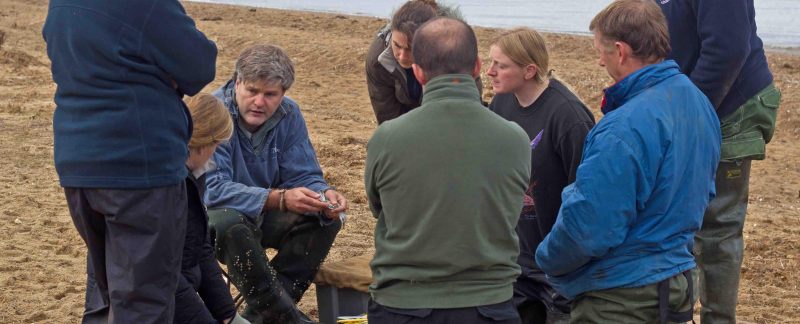
These last for a weekend or longer and will normally aim to make catches either with cannon nets or mist nets on most tides, subject as usual, to weather and recces. We assemble on Friday evening for weekend trips. We colour mark seven wader species (Turnstone, Knot, Grey Plover, Curlew, Black-tailed Godwit, Bar-tailed Godwit and Redshank – see here) and fieldwork sessions generally include some time resighting for colour-marked birds rather than catching.
Additional mist-netting / colour-ring resighting sessions
Additional fieldwork sessions for colour-ring resighting and/or mist-netting may happen when there are suitable tides. Potential dates are listed on the fieldwork programme page. Whether a session will take place is dependent on weather, availability of leaders and level of interest shown, mist-netting being particularly susceptible to weather conditions. Assembly arrangements will be circulated when it is known that it is likely that a session is going ahead.
Colour-mark resighting at other times
If you see colour-marked birds at other times, please report them to the Group via https://washwader.shinyapps.io/sightings/. For resighting queries, please contact sightings@wwrg.org.uk
Participation in WWRG fieldwork
Anyone with an interest in our work is welcome to take part in our fieldwork. We aim to get a good mix of experienced and less experienced participants. To achieve this and prioritise bird welfare and our ability to provide training, we may need to limit the number of attendees. Ringers under the age of 18 must be accompanied by a parent or carer and, in line with BTO policy, we require a parental consent form completing, ideally a week before the start of the trip (and emailed to enquiries@wwrg.org.uk). The form is here. Newcomers are asked to provide a brief resume of their ornithological/ringing experience to aid us both before trips and in the field.
If you would like to come, please get in touch with us via our enquiries email address or via the form on the Contact Us page, well in advance of the trip.
The group aims to visit the Wash and catch waders throughout the year, subject to there being suitable tides.
Winter – Weekend visits are arranged approximately once a month, with additional single tide visits for mist netting. Cannon netting is usually on the east Wash beaches or at sites in the Terrington area. Mist netting is normally at Terrington or Gedney. Most commonly caught species are Oystercatcher, Dunlin, Sanderling, Turnstone, Grey Plover, Redshank, Bar-tailed Godwit and Knot. We assemble on Friday evening for weekend trips.
Summer – Longer visits are arranged during the peak autumn passage period. These make use of opportunities to catch flocks roosting on the saltmarsh and harvested arable fields. During these visits there are often two separate teams. Cannon netting is the main catching technique but mist netting is often used on one or two evenings if it is dark enough. Curlew, Black-tailed Godwit and Ringed Plover are additional species to those listed above which are frequently caught on these visits. The mist netting sessions often catch a greater variety of species.
Colour-Mark resighting
Volunteers are required to look for colour-marked birds at times other than during the Group’s main Fieldwork Programme. Jen Smart is co-ordinating this and if you are willing and able to help with this please contact her via the sightings email address or via the Report a colour-marked bird page. Members wishing to help with a mist-netting session and look for colour mark birds the following morning will normally be able to stay at the Group’s base overnight.
Costs
A charge is made to cover the cost of food and running expenses, including equipment and rings. Current prices are £8 per tide (half day) attended, including the longer visits in August and September. This is reduced to £5 per tide when attending fieldwork sessions when no catching is anticipated. Participants attending for a single tide and not taking advantage of the food / accommodation or other facilities provided by the group) are charged £5. Car drivers are reimbursed by the group for fuel used whilst ferrying people and equipment during the trip. Families are welcome to bring children and charges for children are by negotiation. There are discretionary reductions for unwaged attendees.
Equality, diversity & inclusion
Everyone is welcome and we do not tolerate any form of discrimination. Fieldwork can be physically demanding and may be conducted in all weather conditions – it can be very cold. If you have any condition that may limit your ability to take part in fieldwork please speak to us before you come so that team leaders, and you, know what to expect. We can find ways to make our fieldwork accessible for most people, but many of our field sites are on rough terrain where access is only possible on foot (though we usually have vehicles nearby). Reasonable dexterity is required to handle birds safely.