Fieldwork October 2025

Wednesday 8 – Friday 10 October

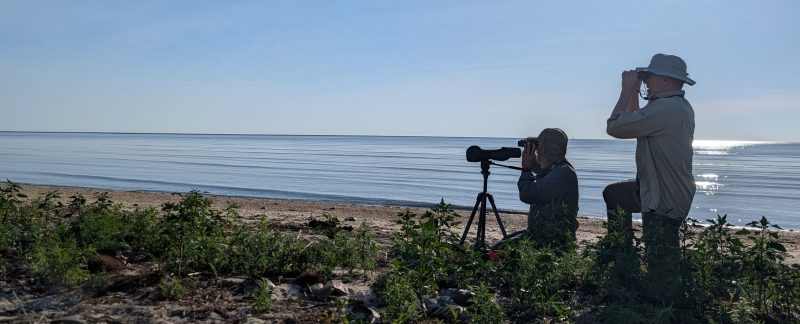
Wednesday, Thursday and Friday morning saw Cathy, Carole and Bernard resighting incredible numbers of Knot at Snettisham Pits. Numbers of 30,000 individuals were reported on Thursday and, over the course of the three days, 112 colour-marked Knot were seen.

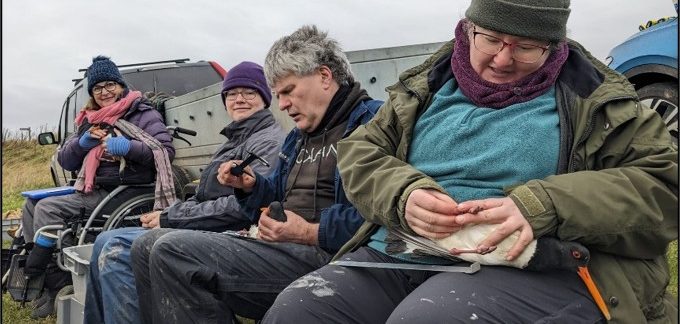
On Friday evening, a small team of only seven arrived at the base house, including Rob, Cathy, Claudia, Hilary, Tanya, Jake and Ingrid. Cathy had a dinner of baked potatoes ready and waiting, and a plan was put in place for the weekend that took into account the unusually small team and the experience level of the group. No catches were planned for Friday night or Saturday morning so a reasonable night’s sleep was in order.

Continue Reading →

Fieldwork September 2025

Saturday 6 September

Team members began to arrive on Friday evening to recce various options for cannon-net catching and resighting on Saturday morning. The previous autumn passage week and this week were relatively limited in terms of very high tides which could push birds onto fields for catching (this week was the marginally better one of the two) or beaches in high numbers. Only Tuesday, Wednesday and Thursday were very high tides.

Continue Reading →

Fieldwork August 2025

The WWRG teams for assembled at the base house for midday on Sunday 10 August. A detailed briefing was given to discuss plans for the first evening’s catch and to introduce first time attendees to the group.

Sunday 10 August

Recces were conducted on the Saturday evening prior to the trip, which included 480 Redshank, 52 Greenshank and 12 Black-tailed Godwit observed at Freiston by Robert P. 300 Sanderling, 30-40 Turnstone, small numbers of juvenile Oystercatcher and Ringed Plover with recently fledged young were observed at Heacham South Beach by Ed and several flocks of the same species were observed by Bee at Heacham North North (NN), including approximately 90 Sanderling. The unsurprisingly dry conditions observed by Richard at Gedney therefore resulted in Heacham NN being identified as the target site for the first evening’s cannon-netting attempt.  

Continue Reading →

WWRG data to be used in a new PhD project

Beyond borders: habitat use of wintering Eurasian Curlew in and around coastal SPAs

We’re pleased to announce that WWRG data will be at the centre of a new PhD opportunity jointly supervised by WWRG members Sam Franks and Katharine Bowgen at the BTO and Christine Beardsworth at Liverpool John Moores University along with Julia Nowack. This PhD will make extensive use of our Curlew ringing and tagging data, along with new fieldwork, to understand winter habitat use of this declining Red Listed species.

Continue Reading →

29 and counting

On the evening of 8 November 2025, WWRG caught 20 Black-tailed Godwits while mist netting at Terrington. One of them was a very special, colour-ringed bird that sets the BTO longevity record every time it is seen.

Metal ring EP85107 was added to a juvenile Black-tailed Godwit on 30 August 1996, in a cannon-net catch at Holbeach, Lincolnshire. It was the first godwit to arrive at the processing team and Jenny Gill added a set of white and green colour rings, turning it into W-GW/W. Jenny was just starting a post-doctoral project at the University of East Anglia to investigate how the expanding population of godwits was spreading into new sites, and needed to be able to recognise individuals. Over sixty birds were colour ringed on that day. Subsequently, there were winter sightings from Ireland, France and Portugal but many of these colour-ringed individuals were found on the estuaries of East and South England, which is where Jenny’s field studies were to be based.

Continue Reading →