
Friday 20 February
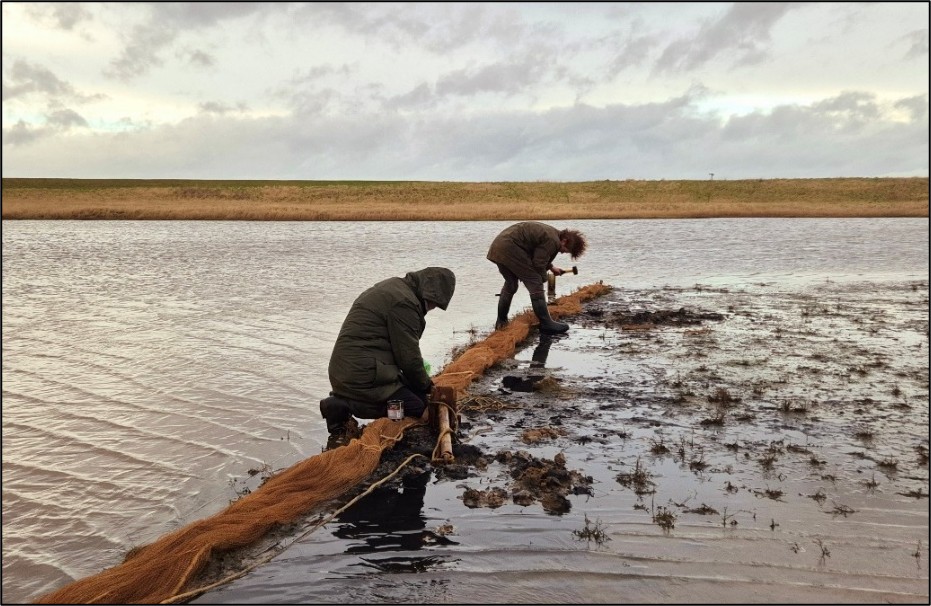
The morning began with Nigel taking a trip to Sailing Club Bay to recce for a potential Oystercatcher catch. Unfortunately, the recent beach recharge had created a pile of sand that would make catching extremely difficult. Fortunately, on Thursday morning, Molly had recced the Horseshoe Lagoon in Lincolnshire and found an incredible flock about 3,000 Oystercatcher, 1,000 Knot, 500 Bar-tailed Godwit and 200 Dunlin. With this being the more favourable catching option, Nigel gathered the cannon-netting gear and met Flo and Liam to set two nets in the Lagoon at 13:30.
A three-cannon small-mesh net was set furthest out on the muddy bed of the Lagoon, and a seven-cannon large-mesh net further back. The plan being to fire one of the two, depending on where the birds roosted. Whilst they sploshed about in the mud, the beautiful sight and sound of 800+ Dark-bellied Brent Geese, swirling about the Lagoon, kept them company and spurred them on. It was cold, wet work for the three setters, pummelled with passing showers for the whole four hours it took to get the nets into position. A great sense of achievement was felt on completion however, and they gladly trundled back to the base house to warm up… or at least they did after rescuing Liam’s Mini, which had become stuck in the mud on the Lagoon wall!
Back at the base, Richard was prepping a lovely jacket potato dinner, and once the rest of the team had arrived and enjoyed some warm food, Nigel led the first team briefing of the trip. As we were dealing with two very different types of nets, a detailed explanation and demonstration of the different lifts involved to safely move the birds out of the water, should we fire, was given. As the plan was gradually laid out for the morning, it quickly became apparent that the majority of the team would be having a very early start to get over to the site and in position in time. We rapidly packed the trailer for the morning , quickly followed by an early bedtime for all.
Saturday 21 February
While darkness still covered The Wash, most of the team arose and left the house by 04:45 hrs. By 06:30 hrs, Nigel, Molly and Lucy were positioned in a hide, and most of the rest of the team were bundled under a tarp in the damp grass on an ‘island’ down in the Lagoon. As the grey morning light slowly grew, birds began to gather, first Curlew and then Oystercatcher and Knot landing in the water. However, just as a decent sample of birds were building in the catching area of the outer, small-mesh net, the problems began. Lapwings descended on the scene and a couple of birds caused havoc by either standing in the safety zone or on top of the net itself. Despite efforts to jiggle these birds away, a male Hen Harrier soon appeared and caused all the Knot, and a large number of Oystercatcher to flush. Eventually, high tide crept up on us and the only option we had left was a smaller flock of Oystercatcher. Molly took the catch and the team ran out from hiding. The birds were quickly moved out of the water, extracted and transported in boxes to the keeping cages behind the Lagoon wall where we’d be processing.
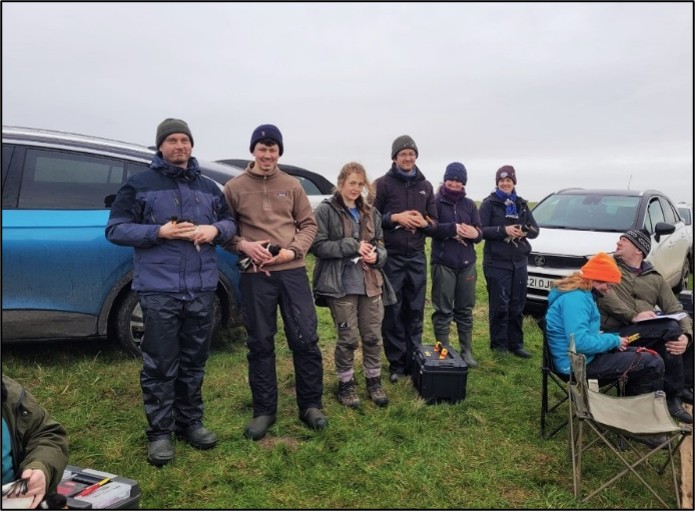
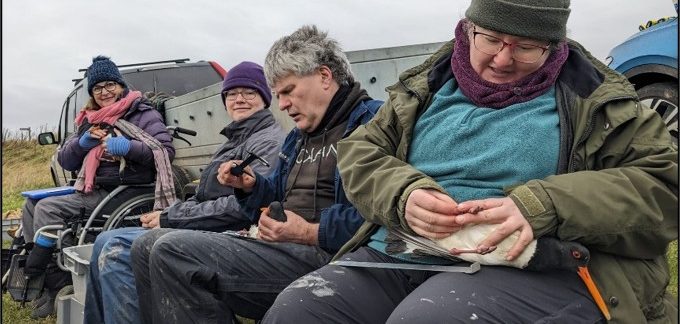
The total catch was 30 Oystercatcher and one Knot. Once the birds had dried and the team had been revitalised by hot tea, coffee and biscuits, ringing and processing began. We had several retraps in our sample of Oystercatcher, two of which were from the same catch in August 2010! Due to the small number of birds caught, this gave the team a great opportunity to deliver some thorough training to those members of the team less experienced with some of the trickier measurements to take on Oystercatcher, such as wing lengths and the various bill measurements. A small team departed to begin cooking a much-needed breakfast, whilst the remaining team members finished processing. We had one bird with a growth on its ‘knee’ which Stanko, who is a vet, was able to safely remove (possibly papilloma) and the bird was released and flew off strongly. Once all the birds were released, the cannon-netting kit was gathered up and the rest of the team set off back to Norfolk.
After a hearty cooked breakfast, a discussion was had to plan the rest of the day. Unfortunately, the weather was just not suitable for mist netting and so instead we planned to use the energy saved to smash out a good bit of resighting in the morning. The team dispersed to pack away the catching kit and crack on with data checking, whilst a small group began preparing dinner. With a little pressure off timings for the evening, everyone was able to have a good rest. The evening weather settled in just as bad as predicted, but a positive turnaround from this was that the team got to enjoy a peaceful evening over dinner, prepared by Phil and Louise, watching the Curling (alas, silver, not gold, for Britain) on Rob Rob’s laptop. With those with no connection to Scotland wondering what all the fuss was about!
Catch totals
| Species | New | Retrap | Total |
| Oystercatcher | 24 | 5 | 29 |
| Knot | 1 | 0 | 1 |
| Totals | 25 | 5 | 30 |
Sunday 22 February
The morning’s main activity was a fantastic effort on resighting. Groups split off in all directions to look for birds with flags and colour rings to record, collecting vital data for the group, some having more success than others…
- Sailing Club Bay, Snettisham Pits, Curlew Fields: Nigel, Liam and Stanko. A small error in tide times (no names mentioned, but they will be using our standard tide tables in future!) meant that resighting Oystercatcher at SCB was impossible, and the team retreated to the Pits. Here there were many Brent Geese, Lapwing and Redshank, but no colour rings in sight. A sign of spring was noted in the increasingly agitated behaviour of the Oystercatcher! Sadly, the field near Heacham South, often a good spot for finding Curlew, was heavily vegetated and no birds were present. Eventually, some fields did produce, and the group managed to find about six WWRG flagged birds and some headstarts.
- Heacham North North to Hunstanton: Louise, Phil and Myles. Roughly 75 Turnstone were found in two groups at Hunstanton, a good find to remember, perhaps for a catch in March. This also provided a perfect opportunity for colour-ring reading, and around 20 combinations were read.
- Heacham Fields: Alex and Claudia. Further investigation of these fields found a good number of Curlew and ten flags read, all different to the birds found by Nigel, Liam and Stanko!
On Saturday, Rob Pell found a Black-tailed Godwit that was colour ringed in Iceland, a bird he has been encountering for at least 12 years. Post resighting on Sunday morning, everyone returned to for some well-earned breakfast. A bit of kit sorting and cleaning commenced, including greasing and oiling of the cannons. But it wasn’t long before, tired from a long but productive weekend, the remaining team members each departed for their journey home.
Resighting totals
| WWRG colour marks | Sightings | Individuals |
| Curlew | 14 | 13 |
| Turnstone | 22 | 22 |
| Black-tailed Godwit | 2 | 2 |
| Marked elsewhere | ||
| Black-tailed Godwit | 1 | 1 |
| Totals | 39 | 38 |
Thank you to everyone involved in making this weekend happen, especially the early-morning recciers, the meal-preppers and the dedicated resighters. Lots of valuable information was gained on this trip and the group certainly learnt some valuable lessons for future expeditions. Looking forward to the next trip in March!
Thanks to Flo Turner and Liam Paulson for writing this report. Cover photo by Chantal Macleod-Nolan