
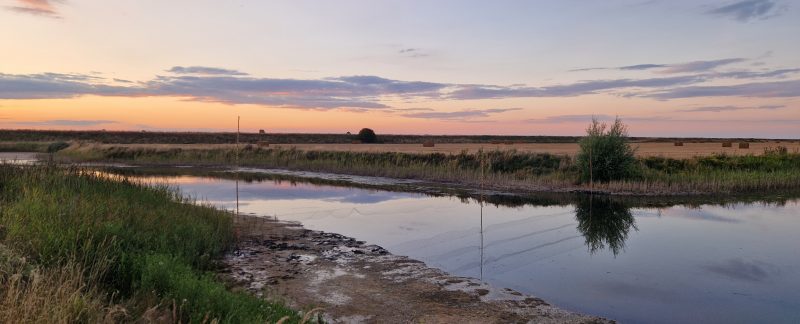
The WWRG teams for assembled at the base house for midday on Sunday 10 August. A detailed briefing was given to discuss plans for the first evening’s catch and to introduce first time attendees to the group.
Sunday 10 August
Recces were conducted on the Saturday evening prior to the trip, which included 480 Redshank, 52 Greenshank and 12 Black-tailed Godwit observed at Freiston by Robert P. 300 Sanderling, 30-40 Turnstone, small numbers of juvenile Oystercatcher and Ringed Plover with recently fledged young were observed at Heacham South Beach by Ed and several flocks of the same species were observed by Bee at Heacham North North (NN), including approximately 90 Sanderling. The unsurprisingly dry conditions observed by Richard at Gedney therefore resulted in Heacham NN being identified as the target site for the first evening’s cannon-netting attempt.
The two teams (Norfolk & Lincs) combined for the catch, which comprised a single cannon net set on a highly disrupted section of Heacham NN beach. A further briefing was given at basecamp by Katharine for the benefit of new attendees which covered the step-by-step process, the unique cannon-netting terminology and how to interact and engage with the public.
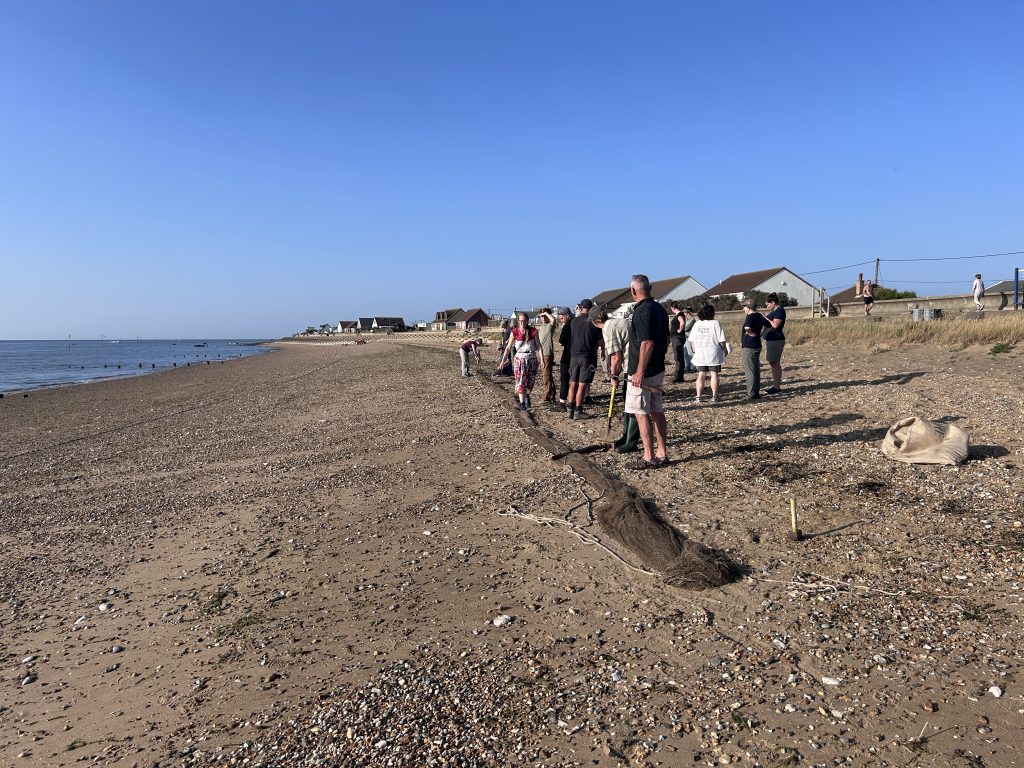
The catch provided a good opportunity for first time attendees to experience setting a cannon net as well as observing some of the common challenges that can arise as a result of ringing in areas with high levels of human disturbance. Jet skis, boats, tractors and members of the public provided a significant challenge for the group prior to the cannons being fired, all of which were managed effectively by the team leads, ensuring that the two nuclei of birds present at either end of the net were sensitively twinkled towards the catching area. The net was fired at 19:36, approximately one hour before high tide, and a total of 21 birds were caught including Turnstone, Sanderling and Ringed Plover.
Three adult Turnstone in active wing moult were added to the colour-ringing project for this species and two colour ringed individuals were retrapped (both originally ringed at Heacham between 2023 and 2024). Greg and Judith, visiting ringers from Australia, were able to ring their first Ringed Plover, and Sanderling and Turnstone were new species for all of the first-time visitors to the wash. Ava, who was attending the passage week as part of her ongoing work on the Darwin Tree of Life Project, was also able to collect blood samples from both Turnstone and Sanderling, two target species for which no previous samples had been collected. The project aims to sequence the genomes of 70,000 species of eukaryotic organisms in Britain and Ireland and Ava is responsible for the collection of samples for all avian species.
Heacham NN cannon-netting totals
| Species | New | Retrap | Total |
| Ringed Plover | 2 | 0 | 2 |
| Turnstone | 9 | 2 | 11 |
| Sanderling | 8 | 0 | 8 |
| Totals | 19 | 2 | 21 |
Monday 11 August
The large team present meant that Monday morning reccies could cover seven sites to assess potential catching opportunities and contribute to resighting efforts. A brief summary of the mornings sightings is provided below.
| Site | Surveyors | Summary |
| Horseshoe | Kirsty and Molly | 30 minutes before high tide approx. 100 Oystercatcher, 50 Dunlin, 500 Redshank and 14 Egret seen at far end of the site. At high tide, numbers observed were very low as a juvenile and adult gull squabbling flushed everything from the area. Five or six Greenshank and four or five Knot were also recorded but no Curlew seen. |
| Freiston | Liam and Hilary | On the old side, 60 Redshank, and approximately 200 Oystercatcher observed. On the new side, 1,200 Oystercatcher, 500 Redshank, 60 Greenshank, 45 Egret, Little Ringed Plover and Curlew Sandpiper were recorded. A few leg flags were also resighted. Site very muddy, with birds distant and dispersed over wide areas making catching opportunities limited. |
| Gedney Pools | Richard and Katharine | Arrived 1 hour 15 mins before high tide, to a small group of Redshank. Numbers gradually increased over the next 40 mins and peaked with 40 Whimbrel, 15–20 Grey Plover, a few Bar-tailed Godwit, one Curlew and numerous gulls. |
| Lawyers | Richard and Katharine | Arrived at high tide with the aim of seeing Greenshank but none were observed. |
| Terrington Marsh | Nigel, Rob R, Chantal and Josh B | Aimed to determine whether any viable cannon-netting options within the marsh pools. All upper pools were not filled at high tide so decided that Terrington Marsh would likely only be an option for mist netting later in the week. Five Spoonbill and approximately 100 Curlew observed close to the tide edge. |
| Snettisham Pits | Greg, Judy, Josh H and Bleddyn | Large numbers of Black-tailed Godwits, Knot, Sanderling and Dunlin. 25 Spoonbills, 20 Little Egret, two Curlew Sandpiper, a handful of Bar-tailed Godwit. Seven colour ringed or flagged birds resighted. |
| Sailing Club | Ed and Bee | Arrived late to scattered groups of Sanderling totalling approx. 2,000+ roosting birds as well as good numbers of Little Tern. Moved down towards main roost near to hides where 1,000+ Bar-tailed Godwit and Curlew were seen. A couple of colour ringed Black-tailed Godwit were resighted. Other species present included a Pectoral Sandpiper, and a White-rumped Sandpiper was reported but not seen. Headed back towards the Sailing Club to look for Bar-tailed Godwits on the falling tide but none seen, although a roost of Mediterranean Gull produced a single colour ringed individual. |
| Sailing Club (on top of building!) | Isla and Bob | Isla and Bob set up a receiver/antenna on the Sailing Club’s roof to detect Isla’s marked Knot. Large flocks of distant waders were observed but no suitable opportunities identified for catching. |
| Heacham | Emily and Ruth | Roughly 300 Sanderling observed in total across two groups and lots of Ringed Plover still present including pairs with chicks. Looking towards the dam, a further 20 Oystercatcher, 50 Sanderling and some gulls. Highlighted as a potential option for Tuesday morning depending on the success of Monday night’s catch. |
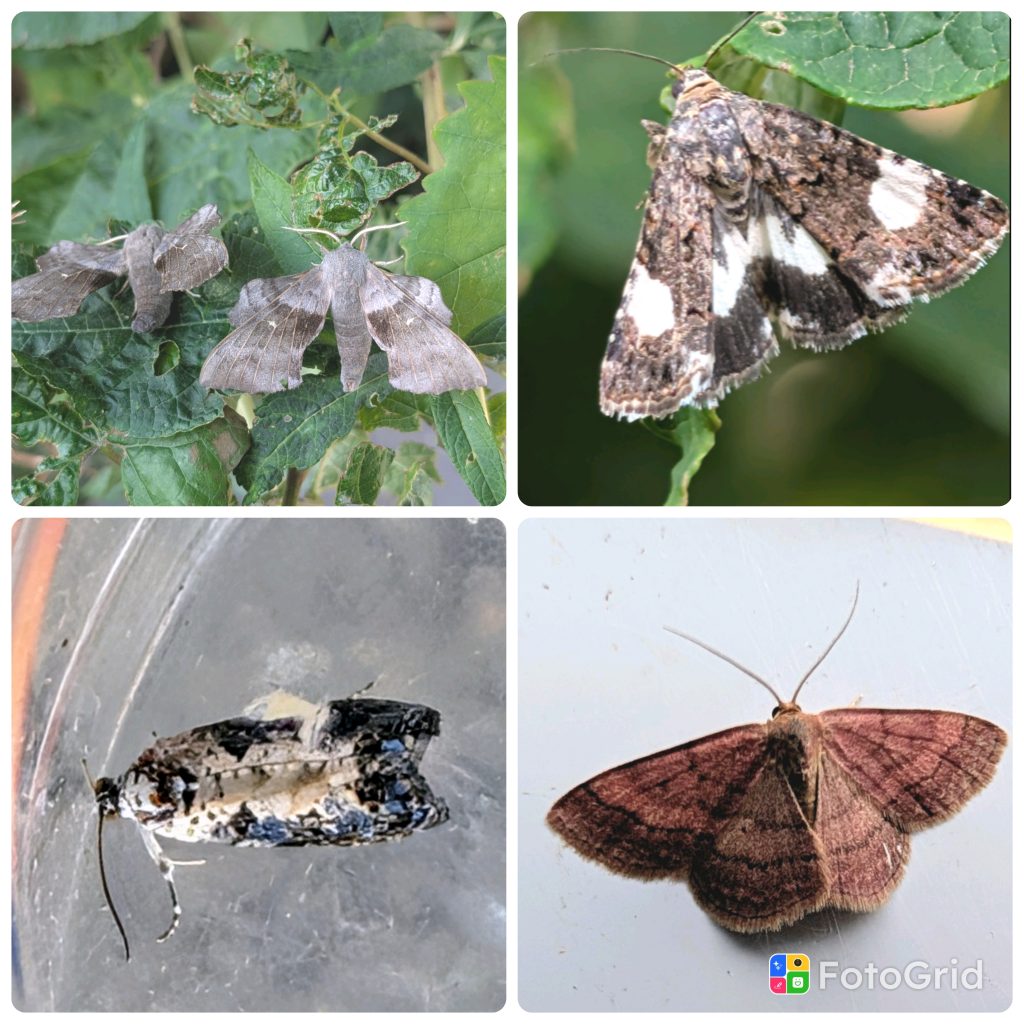
No catching attempts were made on Monday morning which gave the group chance to catch up on some sleep and conduct a short but productive moth trapping session which resulted in a new species for the garden (Jersey Tiger) (the full results of the moth trapping conducted throughout the week are provided at the end of this report).
Planning ahead for Monday evening, discussion included news of nine or 10 GPS tagged Curlew which had been recorded back on the east side of The Wash, between Kings Lynn and Hunstanton. These were birds which had recently been released as part of the Curlew headstarting project. Based on the information gathered from the morning’s recces and historical successful catches, Gedney was selected as the site for Monday evening’s cannon-netting attempt, with Whimbrel being the main target species.
The existing cannon-netting site adjacent to one of the outer pools at Gedney was still intact, but the unfavourable wind direction predicted for the evening meant that a new site had to be sorted out by the net setting team. This ensured that any waders entering the pool on the windward side would not be flying over the net into the catching area. One net was set by a team of twelve experienced ringers who then laid in wait on the marsh, while the rest of the team prepared for the catch back at the sea wall. It was made clear by Nigel during the morning’s briefing that the basecamp may flood but that it ‘shouldn’t’ for that evening’s catch – an experienced team member kindly informed the new attendees to The Wash that ‘If Nigel says you’re going to stay dry, take chest waders!’.
A single net was set and a mixed group of waders comprising Curlew, Whimbrel, Redshank and Grey Plover gradually moved into the catching area. Again, the team were met with some disturbance immediately prior to firing, although on this occasion it came in the form of a large herd of inquisitive young bulls, who helpfully surrounded one of the basecamp teams positioned on the causeway, just as a catching opportunity arose. Luckily, the cattle moved on and the cannon net was fired at 19:59, approximately one hour before high tide and a total of 28 birds were caught including Curlew, Whimbrel, Redshank and Grey Plover. The combined teams worked very efficiently to extract the catch and get all of the equipment off the marsh and back to the sea wall for processing.
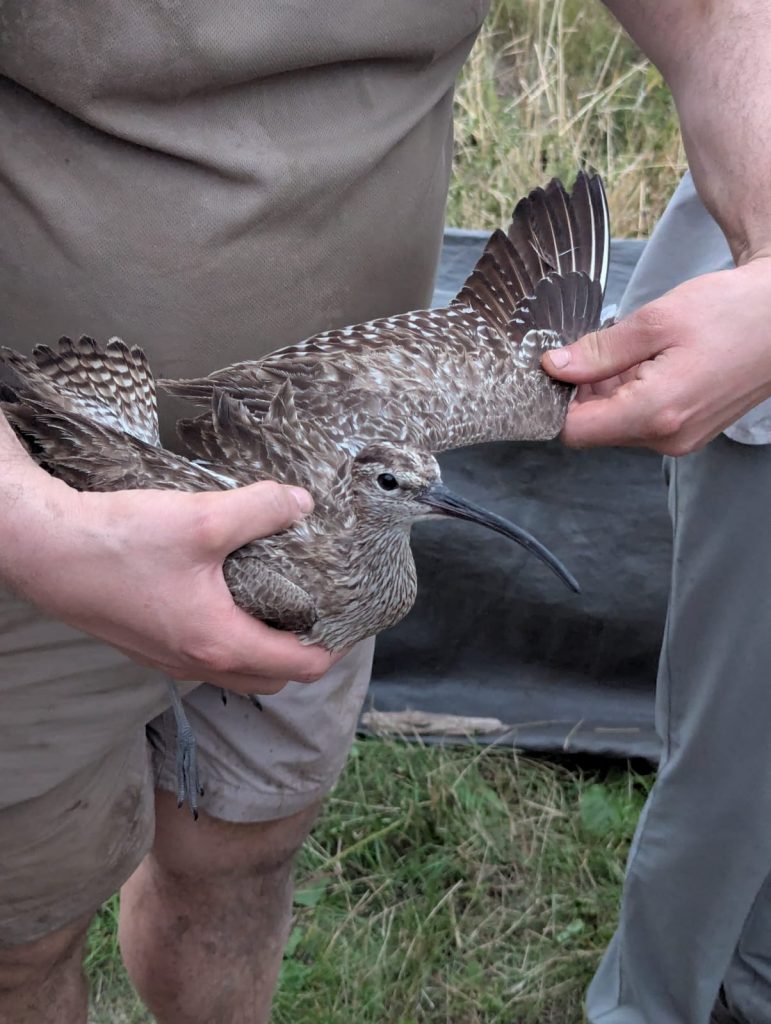
Despite low overall numbers, the catch of eight Whimbrel was particularly impressive as very few are ringed by WWRG each year. The five retrapped Redshank were all originally ringed at Gedney with the oldest record coming from an individual ringed as a ‘3’ in 2016. The catch also gave trainees chance to experience processing larger wader species under the supervision of the team leads. Ava was also able to obtain a further two wader species samples for the Darwin Tree of Life database (Whimbrel and Grey Plover). All in all, a very successful evening!
Gedney Pools cannon-netting totals
| Species | New | Retrap | Total |
| Grey Plover | 3 | 0 | 3 |
| Whimbrel | 8 | 0 | 8 |
| Curlew | 1 | 0 | 1 |
| Redshank | 11 | 5 | 16 |
| Totals | 23 | 5 | 28 |
Tuesday 12 August
A catching option for Tuesday morning at Heacham South Beach had been identified via the reccies on Monday morning. The proposed plan of action was to target the large group of 200–300 Sanderling, whilst ensuring that any Ringed Plover chicks were not significantly disturbed or present within the catching area. Liam and Ed were therefore deployed on Ringed Plover watch at either end of the catching area, while the rest of the team were split evenly between net-setting duties and preparing the processing kit.
Unfortunately, despite the large Sanderling flocks being present for the past couple of days, they did not arrive at the catching area in the numbers expected on this occasion. However, a decision was made to take a smaller catch as the only Ringed Plover present within close proximity to the net was a non-breeding adult and the tide was quickly coming in, something which became very apparent when the team rushed into waist height water to lift the net and walk it towards the strandline. Kirsty informed the group this is commonly known as getting the ‘Giggle Zone’ wet at The Wash! The cannons were fired at 7:56 hrs and 27 birds were caught including the first Knot of the trip in addition to Sanderling and Turnstone. It was turning out to be a good week for Ava, who got to add her fifth new species (Knot) to the genome sequencing project in just three days.
Heacham South Beach cannon-netting totals
| Species | New | Retrap | Total |
| Turnstone | 1 | 0 | 1 |
| Knot | 1 | 0 | 1 |
| Sanderling | 21 | 4 | 25 |
| Totals | 23 | 4 | 27 |
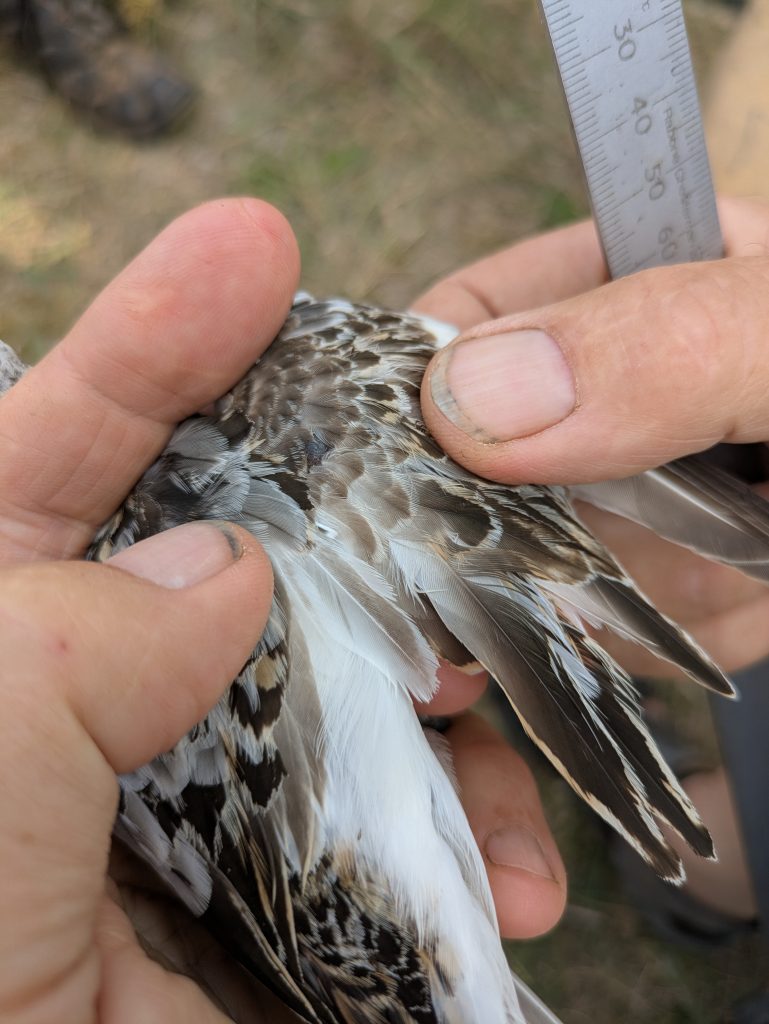
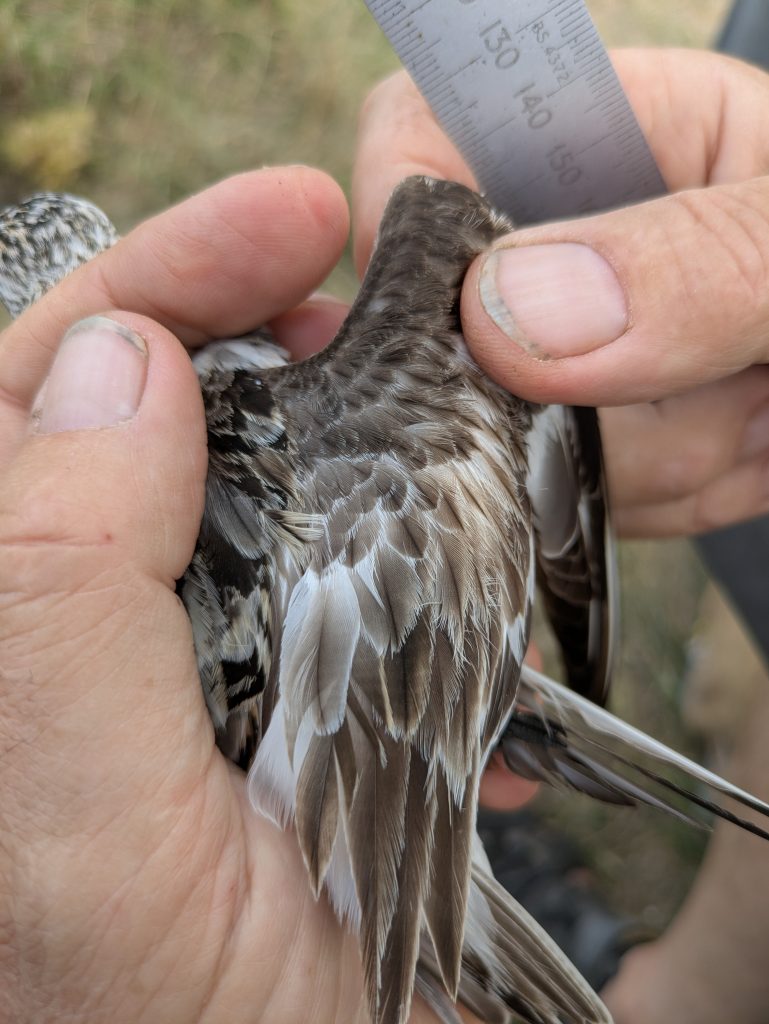
Another smaller catch proved to be very valuable in terms of giving team members more time to study the finer differences in plumage characteristics, more specifically how to distinguish between Sanderling definitely hatched in the previous calendar year (age ‘5’) (photo below left) and those hatched before the previous calendar year but exact year unknown (age ‘6’) (photo below right). Unfortunately, no juveniles from the current year (age ‘3’) were caught, much to Richard’s dismay who had seen good numbers of them along the tide edge that morning!
Upon return to the base house, and following a late breakfast, the team were briefed on the proposed plans and catching options for the remainder of the week. The two teams planned to split up for the evening so that the Lincs team could travel to the Lincs side of The Wash to set nets at a location not trapped at before by WWRG. This was with a view to targeting a large group (1,000+) of Bar-tailed Godwit. The Norfolk team focused on resighting at various sites on the eastern side of The Wash. Two other potential sites in Lincs were discussed. A successful Oystercatcher session on the Lincs side of The Wash was a particular target for the team and therefore one site in the centre of the Horseshoe lagoon was highlighted which had in recent days seen approximately 70 Dunlin and 300 Oystercatcher present. The other option was for Redshank, but the specific site was predicted to be a significantly more challenging area of the Horseshoe to work.
Wednesday 13 August
With the prospect of trapping a large number of Godwit, the teams reconvened on the Lincs side of The Wash early on Wednesday morning to prepare for the catch. The Bar-tailed Godwit are known to favour the lower areas of saltmarsh dominated by Sea Lavender at this site. The Norfolk team arrived at the site on Friskney Flats with the Lincs team already in position, split between two basecamps: one in a hide on the sea wall and one under tarp adjacent to the catching area.
A significant amount of time passed before information arrived from the basecamp hide suggesting that a successful catch was not looking promising. This was due to low numbers of birds in the catching area (who seemed to be slightly put off by the decoys) and the fast approaching rising tide, meaning any catch would likely be very wet! This is despite the presence of roughly 5,000+ waders in the general area. The situation rapidly changed however, and approximately 180–200 birds, comprising mainly of Bar-tailed Godwit and Curlew, piled into the catching area within the space of a matter of minutes. A decision was made to fire, but unfortunately, two of the cannons misfired due to a combination of equipment issues and a higher than expected tide. A single Curlew and two by-catch Skylarks were a consolation for the group. This was a frustrating result for the team but at the very least provided some good reconnaissance for any future catches at the new site.
Friskney Flats cannon-netting totals
| Species | New | Retrap | Total |
| Curlew | 1 | 0 | 1 |
| Skylark | 2 | 0 | 2 |
| Totals | 3 | 0 | 3 |
The teams attended a de-brief at Friskney Village Hall and discussed plans for the evening’s catch options. A recce was conducted by Steve to the Horseshoe Lagoon to assess its suitability for a catch, taking into account recent modifications to some pipework on the outer wall that feeds water into the lagoon. A group of 150 Redshank were present which were flushed by a tractor cutting grass, and then later replaced by approximately 80 Oystercatcher and 100 Dunlin. A number of birds were also observed roosting on the two cannon-net setting areas adjacent to the central island on the lagoon. A decision was made to set the nets that afternoon. This required some repairs to the setting positions before deploying one three-cannon net and one four-cannon net. With the morning’s misfire fresh in the mind, extra efforts to ensure the cannons did not suffer any water ingress were made, including greasing the cartridges and cannon bases, as well as wrapping the cannons in black plastic bin bags. The nets were grotted and left in position ready for the following morning.
Focus turned to the evenings mist netting opportunities, and a plan was made to split the teams again to target two different sites. The Lincs team, led by Steve, headed to Freiston to target Redshank while the Norfolk team, led by Nigel and Jacquie, headed to Friskney to target a mixture of species utilising an outer pool on the marsh.
At Freiston, mist nets were set in a large U-shape configuration while at Friskney, nine mist nets were set across a pool in three separate lines configured to be across the wind so that they produced large pockets into which waders could be caught. Again, for both sites, the conditions were not favourable for a significant catch, as the times for high tide and sunset coincided in a way which meant that the nets were too visible for flocks of birds attracted to the area by sound lures. The numbers of birds caught at each site were therrefore low but included a nice mix of species. Six Redshank were also flagged by the Lincs team at Freiston adding more valuable data to the project.
Freiston mist-netting totals
| Species | New | Retrap | Total |
| Grey Plover | 1 | 0 | 1 |
| Turnstone | 1 | 0 | 1 |
| Dunlin | 1 | 0 | 1 |
| Redshank | 6 | 0 | 6 |
| Totals | 9 | 0 | 9 |
Friskney Flats mist-netting totals
| Species | New | Retrap | Total |
| Oystercatcher | 1 | 0 | 1 |
| Bar-tailed Godwit | 3 | 1 | 4 |
| Knot | 6 | 0 | 6 |
| Dunlin | 3 | 0 | 3 |
| Totals | 13 | 1 | 14 |
Towards the end of ringing and processing, a large thunder and lightning storm was closing in on both teams. The Lincs team were able to pack up their kit just as the first rain droplets began to fall but this was not the case for the Norfolk team. With cracks of lightning becoming more frequent In the poor visibility, the team took an unusual route off the field. A memorable end to the nights catch!
Thursday 14 August
The teams were back out on site at the Horseshoe Lagoon on Thursday morning, to try for the mixed group of Redshank, Oystercatcher and Dunlin observed by Steve the morning prior. Everyone was in position before the rising tide and unfortunately, continued to be in position for the next three hours, right up until high tide. The birds arrived as planned, adjacent to the catching area, and opportunities arose for a smaller catch (approx. 50 Oycs), but the decision was made to postpone to the following morning due to more favourable winds being forecast. The winds on Thursday morning meant that the groups of Oystercatcher and Dunlin present were shifted further and further away from the catching area and were also likely spooked by a Marsh Harrier and a pair of Peregrine seen flying over the site. The limitations of firing a small-mesh net into a headwind was also a contributing factor (a small-mesh net fired into a headwind doesn’t go out as fast as a standard-mesh net, which is less affected by the wind). Therefore, the leads felt that it was better to try and catch a larger sample the following day.
The evening’s mist-netting attempts comprised splitting into two teams; one larger team would target a mixture of species on an outer pool at Wrangle Tofts while a smaller team would target Redshank at the Horseshoe Lagoon. At Wrangle Tofts, 15 mist nets were deployed in a large ‘E’ shape where a much more productive catch was anticipated based on the tide and sunset times. At the Horseshoe Lagoon a smaller number of nets were set in a big ditch near the lagoon.
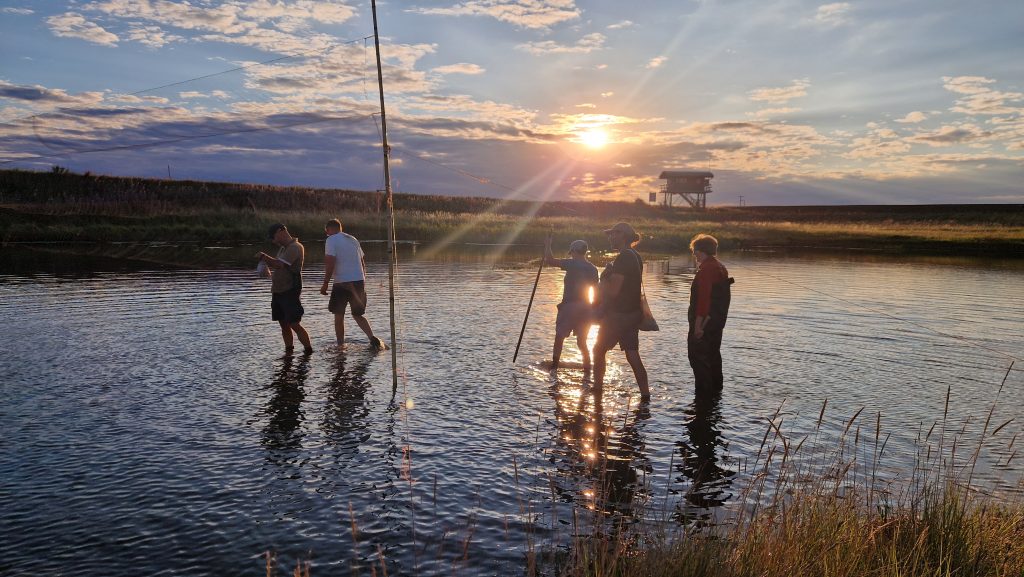
As predicted, more favourable conditions meant that a total of 97 birds were caught and processed by the Wrangle Tofts team, comprising 90 new individuals and seven re-traps. The seven retrapped birds were all Bar-tailed Godwits and comprised individuals mainly ringed at Leverton and Wrangle Tofts, two of which were originally ringed in 2006. However, one of the birds retrapped was a control that was ringed on 01/04/2025 in Griend, Netherlands (see photos below). A single Ruff and single Greenshank were new species for the week (see photos below), which enabled Ava to tick off another two wader species for the Darwin Tree of Life Project. A smaller catch was achieved at the Horseshoe Lagoon with 13 birds of three species being ringed.
Wrangle Tofts mist-netting totals
| Species | New | Retrap | Total |
| Grey Plover | 1 | 0 | 1 |
| Whimbrel | 3 | 0 | 3 |
| Curlew | 4 | 0 | 4 |
| Bar-tailed Godwit | 30 | 7 | 37 |
| Knot | 3 | 0 | 3 |
| Ruff | 1 | 0 | 1 |
| Dunlin | 5 | 0 | 5 |
| Redshank | 42 | 0 | 42 |
| Greenshank | 1 | 0 | 1 |
| Totals | 90 | 7 | 97 |
Horseshoe Lagoon mist-netting totals
| Species | New | Retrap | Total |
| Knot | 1 | 0 | 1 |
| Dunlin | 5 | 0 | 5 |
| Redshank | 7 | 0 | 7 |
| Totals | 13 | 0 | 13 |
Friday 15 August
Friday morning’s second cannon-netting attempt at the Horseshoe Lagoon unfortunately culminated in the same outcome as the first attempt, with no suitable catching opportunities presenting themselves. This was particularly frustrating for those under the tarp who had done back-to-back three-hour shifts lying in wait, but at least it remained dry!
After packing up the kit and having a well-earned breakfast, Friskney Village Hall was cleared and tidied before both teams headed back to the Norfolk base. Attention turned to preparing for the final session of the week which was planned for Terrington Marsh. With conditions looking promising, the Norfolk and Lincs teams joined forces to set mist nets on the marsh and prepare the ringing and processing basecamp in the adjacent barn. It was certainly a case of saving the best till last as Friday evening turned out to be the most successful catch of the week with 130 birds of 11 species being caught and processed.
Terrington Marsh mist-netting totals
| Species | New | Retrap | Total |
| Oystercatcher | 4 | 0 | 4 |
| Grey Plover | 4 | 0 | 4 |
| Ringed Plover | 1 | 0 | 1 |
| Whimbrel | 4 | 0 | 4 |
| Curlew | 2 | 0 | 2 |
| Bar-tailed Godwit | 1 | 0 | 1 |
| Black-tailed Godwit | 2 | 0 | 2 |
| Turnstone | 17 | 3 | 20 |
| Knot | 30 | 1 | 31 |
| Dunlin | 12 | 0 | 12 |
| Redshank | 45 | 4 | 49 |
| Totals | 122 | 8 | 130 |
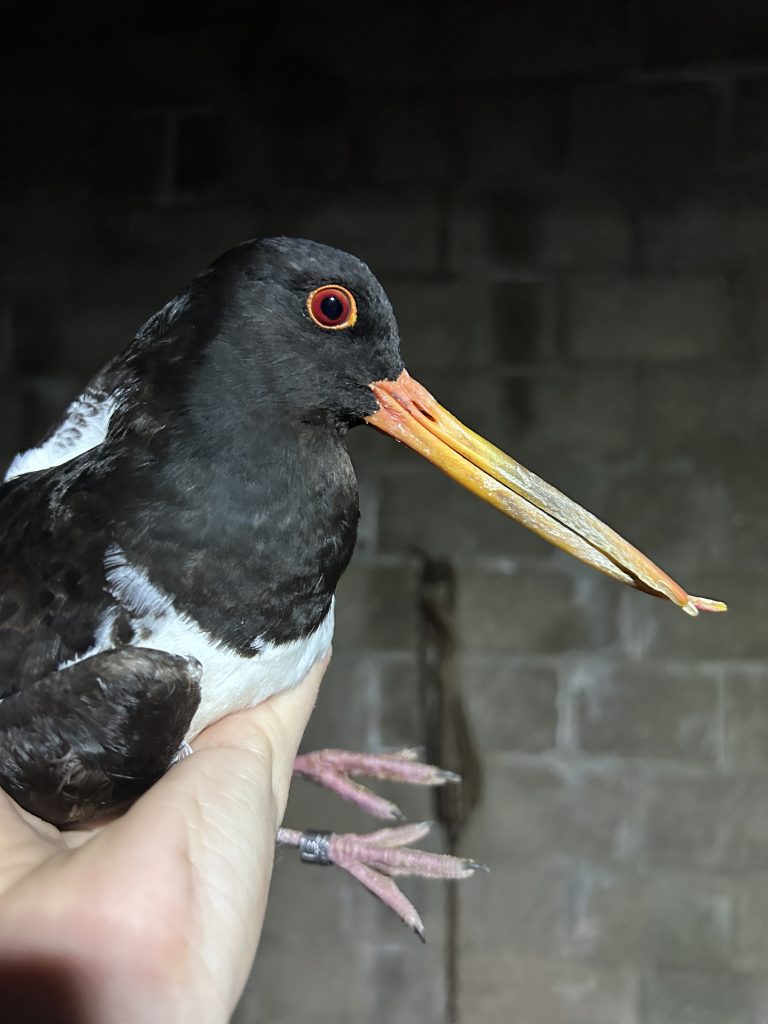
A nice mix of species including good samples of Turnstone, Knot and Redshank were a welcome end to the trip. An interesting adult Oystercatcher with crossed mandibles was also caught, which was aged as an 8 (i.e. Hatched three or more years ago, exact year unknown), so seemingly not hindered by the bill deformity when foraging! All of the retrapped birds were originally ringed at Terrington between 2012 and 2025, and it was noted by Richard following the trip that WWRG have caught approx. 3,600 Redshank between Gedney and Terrington over the last decade and yet have recorded no movements between the two sites, which are just 10 km apart.
Saturday 16 August
A final de-brief was delivered by Nigel and the other team leads on Saturday morning, summarising the highlights of the trip. Before departure from the base house, the teams worked together to clean and store equipment in preparation for Passage Week Two.
The week was a clear success, with 340 individuals from 14 species processed. Notable captures included strong samples of Turnstone, Knot, and Redshank, along with less-frequently caught species such as Greenshank, Ruff, and Whimbrel. The week also marked a significant positive contribution by WWRG to the Darwin Tree of Life Project.
Although overall numbers were lower than anticipated, favourable weather conditions and an abundance of training opportunities made it a rewarding experience for both new participants and returning team members.
Passage Week 1 ringing totals
| Species | New | Retrap | Total |
| Oystercatcher | 5 | 0 | 5 |
| Grey Plover | 9 | 0 | 9 |
| Ringed Plover | 3 | 0 | 3 |
| Whimbrel | 15 | 0 | 15 |
| Curlew | 8 | 0 | 8 |
| Bar-tailed Godwit | 34 | 8 | 42 |
| Black-tailed Godwit | 2 | 0 | 2 |
| Turnstone | 28 | 5 | 33 |
| Knot | 41 | 1 | 42 |
| Ruff | 1 | 0 | 1 |
| Sanderling | 29 | 4 | 33 |
| Dunlin | 26 | 0 | 26 |
| Redshank | 111 | 9 | 120 |
| Greenshank | 1 | 0 | 1 |
| Total | 313 | 27 | 340 |
Trip colour-mark resighting totals
| Species | WWRG total sightings | WWRG individuals | Non-WWRG |
| Bar-tailed Godwit | 7 | 7 | 0 |
| Curlew | 0 | 0 | 0 |
| Turnstone | 64 | 48 | 0 |
| Black-tailed Godwit | 0 | 0 | 55 |
| Knot | 4 | 4 | 15 |
| Redshank | 4 | 4 | 2 |
| Sanderling | 0 | 0 | 1 |
| Oystercatcher | 2 | 1 | 0 |
| Total | 81 | 64 | 73 |
Moth-trapping totals
| Species (scientific name) | Species (common name) | Totals | ||
| 11/08/2025 | 13/08/2025 | 15/08/2025 | ||
| Macros | ||||
| Phlogophora meticulosa | Angle Shades | 1 | ||
| Diachrysia chrysitis | Burnished Brass | 1 | ||
| Mamestra brassicae | Cabbage Moth | 1 | ||
| Mythimna ferrago | Clay | 1 | ||
| Mesapamea secalis agg. | Common Rustic agg. | 1 | 2 | |
| Mythimna pallens | Common Wainscot | 3 | 9 | 45 |
| Agrotis ipsilon | Dark Sword-grass | 1 | ||
| Axylia putris | Flame | 1 | ||
| Ochropleura plecta | Flame Shoulder | 1 | ||
| Luperina testacea | Flounced Rustic | 1 | 1 | |
| Tyta luctuosa | Four-spotted | 1 | ||
| Agapeta hamana | Garden Straw | 1 | ||
| Agrotis exclamationis | Heart and Dart | 1 | ||
| Noctua pronuba | Large Yellow Underwing | 3 | ||
| Noctua janthe | Lesser Broad-bordered Yellow Underwing | 1 | ||
| Eupithecia centaureata | Lime-speck Pug | 1 | ||
| Hadena bicruris | Lychnis | 1 | ||
| Bryophila domestica | Marbled Beauty | 1 | ||
| Anarta trifolii | Nutmeg | 1 | 3 | 12 |
| Caradrina clavipalpis | Pale Mottled Willow | 1 | ||
| Laothoe populi | Poplar Hawk-moth | 2 | 1 | |
| Idaea aversata | Riband Wave | 1 | ||
| Xestia c-nigrum | Setaceous Hebrew Character | 6 | 18 | 35 |
| Agrotis puta | Shuttle-shaped Dart | 1 | 4 | |
| Denticucullus pygmina | Small Wainscot | 1 | 1 | 1 |
| Abrostola tripartita | Spectacle | 2 | ||
| Thalpophila matura | Straw Underwing | 2 | 1 | |
| Scopula rubiginata | Tawny Wave | 1 | ||
| Agrotis segetum | Turnip Moth | 1 | 10 | |
| Hoplodrina ambigua | Vine’s Rustic | 4 | 16 | |
| Mythimna albipuncta | White-point | 1 | 4 | 12 |
| Micros | ||||
| Catoptria falsella | Chequered Grass-moth | 1 | ||
| Agriphila tristella | Common Grass-moth | 2 | 1 | 1 |
| Epiphyas postvittana | Light Brown Apple Moth | 1 | ||
| Patania ruralis | Mother of Pearl | 1 | ||
| Hedya salicella | White-backed Tortrix | 1 | ||
| Totals | 19 | 56 | 154 | |
Thanks to Josh Brown for writing this report. Header image by Isla Botting.