
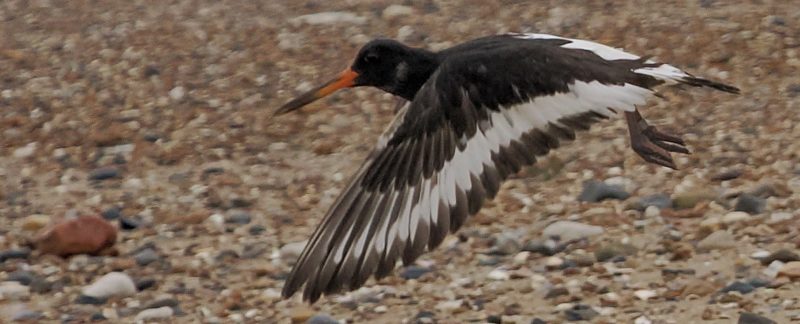
Friday 7 November
An early recce on the morning tide on Friday (Cathy, Lys and Hilary) produced a group of c. 200 Curlew and some Sanderling on Heacham Beach. Cathy then had a very successful resighting session at Heacham, while Lys and Hilary recced elsewhere. Jacquie and Nigel went to recce Heacham Beach for net placement on the tide line for an attempted Curlew catch on Saturday morning. Hilary had also visited Frampton Marsh the previous day, reporting it to be very dry with almost no waders seen. Meanwhile, Cathy resighted two Bar-tailed Godwit and one headstarted Curlew at Snettisham.
The team assembled across Friday evening and, after a dinner of baked potatoes, headed out to set the nets on the beach ready for the following morning. Two nets (20 x 11.3 m, small-mesh) were set side by side, with an aim to catch 30–50 Curlew for colour-ringing, with any headstarted birds to have a GPS tag attached.
Saturday 8 November
Guy and Ros were up early and in the hide by 05:30 hrs. The rest of the team were in place by 06:30 hrs, staying hidden behind the sea wall. Longstops were needed, as when Guy and Ros had arrived an early dog walker had already disturbed the roosting Curlew flock, which returned to the beach in smaller groups both north and south of the nets. Cathy twinkled the northern groups down towards the nets, with Rob nudging from the south. A group of 30–40 ended up in front of the lower net but seemed very wary – though initially they seemed attracted to the area, possibly the removal of the saltwort from the beach or the presence of the decoys put the birds on alert.
As one bird was still flying around, the nets could not be fired. The birds then flew off and a smaller group of 15 returned to the beach in front of the net. Though they were slightly lower on the beach than ideal, this was felt to be the only realistic catching opportunity of Curlew for the day, and so the nets were fired (at 07: 06 hrs). Most of the Curlew beat the net on the tide edge, but we caught seven birds. These birds were swiftly extracted from the net, and the net removed from the beach, leaving the second still in place. Cathy again went north of the nets to twinkle a flock of c. 300 Sanderling southwards, and the second net was fired shortly after at 07:33 hrs, successfully catching 47 Sanderling.
All birds were then processed and released , with time for training less-experienced team members in processing. Both catches produced a good number of retraps, with a 50/50 ratio of new to subsequent records. Liam, Hilary and Rob did resightings on the falling tide at Heacham after the catch, though the mud was very slow to appear and they did not have much luck. Meanwhile, Lys, Sam, Skye and Eden spotted two flagged Curlew amongst a group of 30 on a field off the Knightshill roundabout.
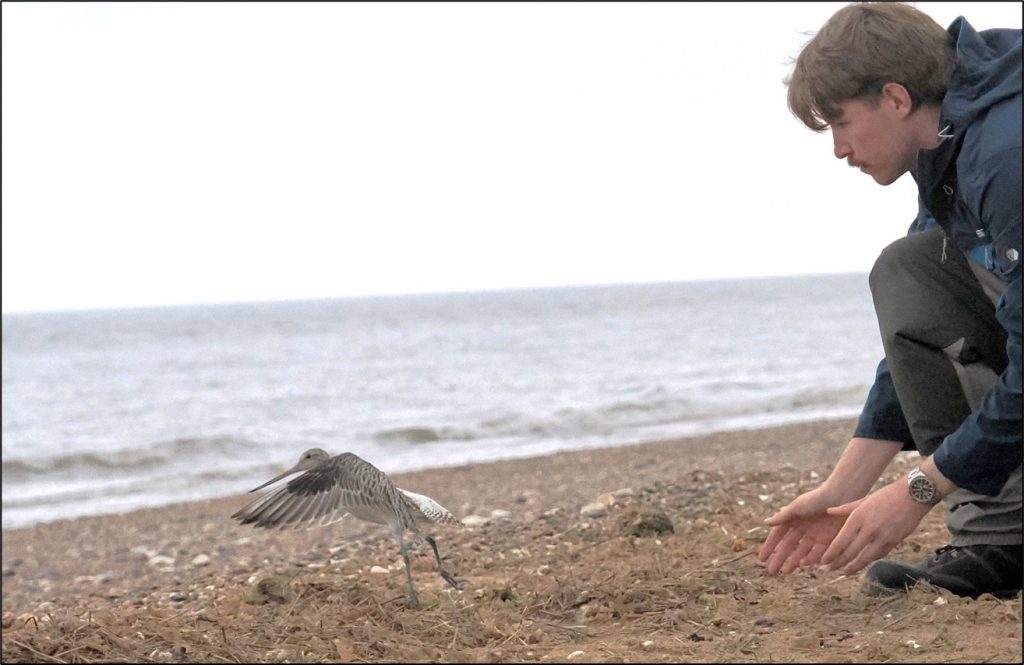
Capture totals from cannon-net catch on Heacham beach.
| Species | New | Retrap | Total |
| Catch 1 | |||
| Curlew | 1 | 1 | 2 |
| Bar-tailed Godwit | 1 | 0 | 1 |
| Oystercatcher | 3 | 1 | 4 |
| Catch 2 | |||
| Sanderling | 22 | 25 | 47 |
| Totals | 27 | 27 | 54 |
The team returned to base for a cooked breakfast and, after a short rest, headed out at 14:15 hrs to set nets on Terrington Marsh for mist netting on the evening high tide. Two lines of five nets were set on the outer pool, with most of the team then returning to base for an early and delicious evening meal of vegetable stew and crumble while Molly stayed with the nets. Liam, Claire & Harriet returned to place sound lures at the net at dark, with the rest of the group assembling shortly afterwards near to the nets on the marsh.
Two busy net rounds followed, with a good number of godwit caught in the first (and Olly’s first wader extraction turned out to be a Spotted Redshank!) and a mix of species in the second. A third net round just before 20:00 hrs produced a handful of birds only and owing to the number of birds to be colour ringed it was then decided to close the nets and return to base for processing. A total of 71 birds were caught, across a mix of species. This included the oldest ringed Black-tailed Godwit (see 29 and counting)! This bird (WT/- 1| GW/WM) was ringed by Jenny Gill as a juvenile on 30 August 1996, breeds in North Iceland, and winters all around East England. It is frequently seen by WWRG resighting teams on Snettisham Pits.
Capture totals from mist-net catch on Terrington Outer Pool.
| Species | New | Retrap | Total |
| Black-tailed Godwit | 18 | 2 | 20 |
| Bar-tailed Godwit | 4 | 0 | 4 |
| Oystercatcher | 3 | 0 | 3 |
| Turnstone | 3 | 0 | 3 |
| Knot | 18 | 0 | 18 |
| Dunlin | 10 | 0 | 10 |
| Redshank | 10 | 1 | 11 |
| Spotted Redshank | 1 | 0 | 1 |
| Totals | 67 | 3 | 70 |
Sunday 9 November
After a very busy Saturday, the team had a more relaxed Sunday morning, with a team heading out to Snettisham Pits arriving at high tide (Lys, Lynda, Connie, Harriet, Olly and Claire). The tide was not high enough to push birds over into the pits. One Turnstone was resighted in the pits and one Curlew on the beach, with several other flagged Curlew photographed for attempted ID later. Molly and Liam headed out to do resightings around Heacham, while Hilary and Sam went to do resightings on the falling tide at Heacham South later on. Meanwhile, Rob checked fields for Curlew, finding seven flagged birds amongst a flock of 50 at Ingoldisthorpe. There was just one Curlew in the field at the Knightshill roundabout this time, while a buzzard was sitting in the middle of another otherwise ideal field.
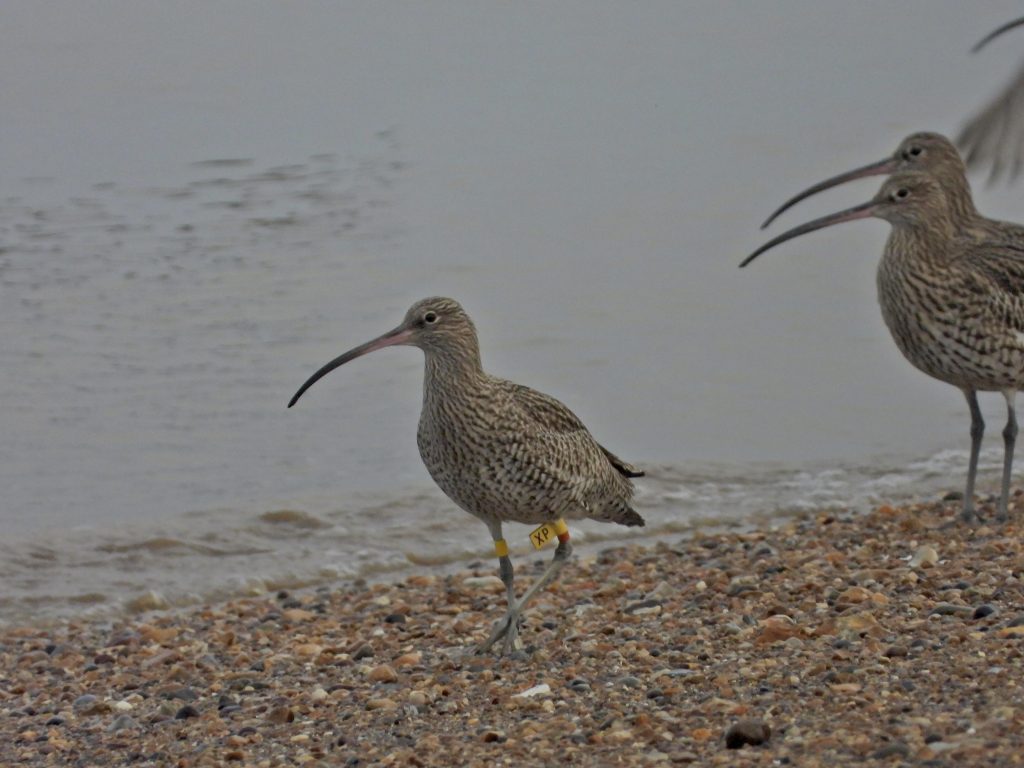
Trip ringing totals
| Species | New | Retrap | Total |
| Curlew | 1 | 1 | 2 |
| Black-tailed Godwit | 18 | 2 | 20 |
| Bar-tailed Godwit | 5 | 0 | 5 |
| Oystercatcher | 6 | 1 | 7 |
| Turnstone | 3 | 0 | 3 |
| Knot | 18 | 0 | 18 |
| Dunlin | 10 | 0 | 10 |
| Redshank | 10 | 1 | 11 |
| Spotted Redshank | 1 | 0 | 1 |
| Sanderling | 22 | 25 | 47 |
| Total | 94 | 30 | 124 |
Colour-mark resighting totals
| Species | Total Sightings | Individuals | Non-WWRG |
| Curlew | 53 | 44 | 0 |
| Knot | 1 | 1 | 3 |
| Bar-tailed Godwit | 6 | 6 | 0 |
| Turnstone | 10 | 10 | 0 |
| Total | 70 | 61 | 3 |
The weekends resighting efforts generated records of 17 different individual headstarted Curlew from all release year cohorts.
Thanks to Connie Tremlett for writing this report. Cover image by Cathy Ryden.