
Friday 5 December
Before the majority of the group arrived for the weekend, recces were carried out on Friday morning. Cathy visited Snettisham beach arriving at 06:30 hrs in full moonlight. Snettisham Beach held no waders and Heacham just two Oystercatchers. The spit at the Sailing Club Bay was next to view where three Bar-tailed Godwit were resighted among a huge flock of mixed waders. Nigel then joined on video call to view the beach and assessed that, with no feathers or poo found, the Oystercatchers had not roosted there over high tide.
Unfortunately, the majority of the sites where catches would usually be made had low numbers of birds, and the high tides were during dark. This limited the number of opportunities available to carry out any cannon-net catches for the Saturday morning, therefore the decision was taken not to set nets on the Friday evening. There was a forecast of heavy rain, strong winds and a full moon, so mist netting was called off.
Cathy checked Snettisham beach on the afternoon rising tide and found it was again empty of birds. Molly viewed Heacham NN with a thermal imager and had a good flock of Ringed Plover which left before high tide; however, a recce at Heacham South by Tim (around 15:00 hrs) showed promise. Approximately 200 Bar-tailed Godwit and Curlew were seen to be using the mudflats, with the rising tide pushing the birds up from the mudflats onto the shingle shore. This is a site where birds have been caught in the past, therefore it seemed a good option to make a cannon-netting attempt for Saturday afternoon.
Everyone was grateful to have a delicious meal (jacket potatoes and salad) ready for them once they had arrived from their wind and rain-swept journeys. Having eaten, people made their way to bed, ready for the following morning.
The decision was made for people to split into three teams to go resighting on Saturday morning. One team (Ros and Tim) would recce Heacham South in order to plan for the proposed cannon-net catch, another team (Molly, Harriet and Mark) would go to Heacham North North (NN), and the final team (Claudia, Bill and Bleddyn) would check the fields around Dersingham and Sandringham to look for Curlew. A back up team (Ali, Michele, Nick and Cathy) were allocated to house roles.
Saturday 6 December
The Heacham teams left by 05:30 hrs to get to their respective sites before high tide. The Heacham NN team had set out to do some resightings, but poor weather limited their ability to get any good views, especially as the tide started to fall and birds retreated further out onto the mudflats. They decided to join the Curlew team (who were lucky enough to not need to leave until 07:00 hrs) on their search of the fields around Dersingham and Sandringham. After a rather sorry start by the Curlew team, with no birds spotted around Dersingham, a flock of approximately 70 Curlew were found on a field beside Bircham Windmill, with some flagged individuals positively identified. The Heacham NN team checked the playing field in Terrington on their way back but as it was in use there were no birds to view.
The Heacham South team were able to arrive with enough time before high tide in order to watch the flock move up the shore with the rising tide, allowing for a plan for a catch to be made. Because high tide would be before sunrise, the flock would be viewed with a thermal imager. The team observed that the mudflats below the sandy shingle at Heacham South were submerged from about two and a half hours before high tide. The rising tide moved quickly on the shallower mudflats, but once it hit the steeper shingle it moved more slowly, meaning the flock were slower to move up the shingle part of the shore.
Meal preparation was hampered by a three-hour localised power cut which meant we had no use of the ovens so everything had to be cooked on the gas hob. Thanks to Ali and Harriet for coping with the hiccup this caused. After everyone had returned and had their breakfast, a plan was made to set three nets on Saturday afternoon, ready for a catch on the next high tide that same afternoon. With the trailer packed, we set off for Heacham South at 12:30 hrs.
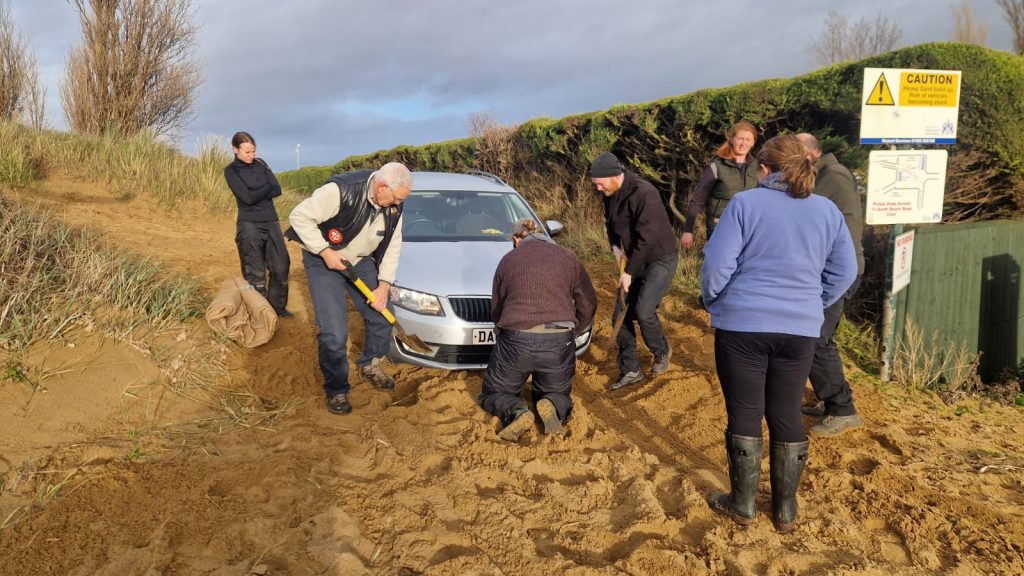
Once we had arrived, a film crew arrived to get some footage for a proposed follow-on documentary looking at the international reach of WWRG. They wanted to interview Mark and get some footage of the cannon nets being set. As always happens when time is of the essence, as the tide was making its way in fate decided to put some obstacles in our way. Firstly, the car (with unfamiliar to Norfolk navigators) towing the trailer (with all the equipment needed to set up the cannon nets) got stuck in the sand, needing a team of diggers to get it out (note the caution sign in the photo)! Once the car had been freed, the trailer was unhooked and unpacked. Unfortunately, this was quite a distance from where the nets were going to be set, which meant quite a few long back-and-forth trips between the trailer and the beach with equipment, taking up time which we were already short of. Finally, the battery in Nigel’s car had died at the gate entrance to Heacham South, which meant another trip to go and grab the required equipment from there before we could finish setting up! Yet, despite these problems, we got the nets set up and everyone got into position as the sun was starting to set.
The set-up included one net being set on the boundary between the shingle and the mud-flat, providing the opportunity to catch the flock before it got too late after sunset. But if that net was unsuccessful in catching that afternoon, it could be removed before it got covered by the rising tide. Just above the high tide line on the shingle, another two small-mesh nets were set in a single line. By setting them there, they could be left, allowing for another catching attempt to be made around high tide the following morning, hopefully in daylight.
With base camp behind the dunes, Nigel in the firing position on the shore, Alastair and Mark as long stops, and Bleddyn as an emergency twinkler, we waited until the flock arrived on the mudflat, hopefully in front of the single lower net. Some decoys had been placed in front of this cannon net with the hope of attracting the flock to a suitable catching position.
Unfortunately, two Curlew which arrived at the beach first did not land in line with the cannon net. They then became the nucleus of the flock that later arrived, with the rest of the arriving birds landing around them, with few in front of the cannon net. As time went on, the birds became more and more flighty, with numerous individuals in the flock leaving. It was also getting darker as we were out beyond sunset, making it more difficult to see the birds with the naked eye, and only a small number of birds were catchable. The combination of these factors led to the catch being called off and we had enough time to collect the lower cannon net before it was submerged by the rising tide.
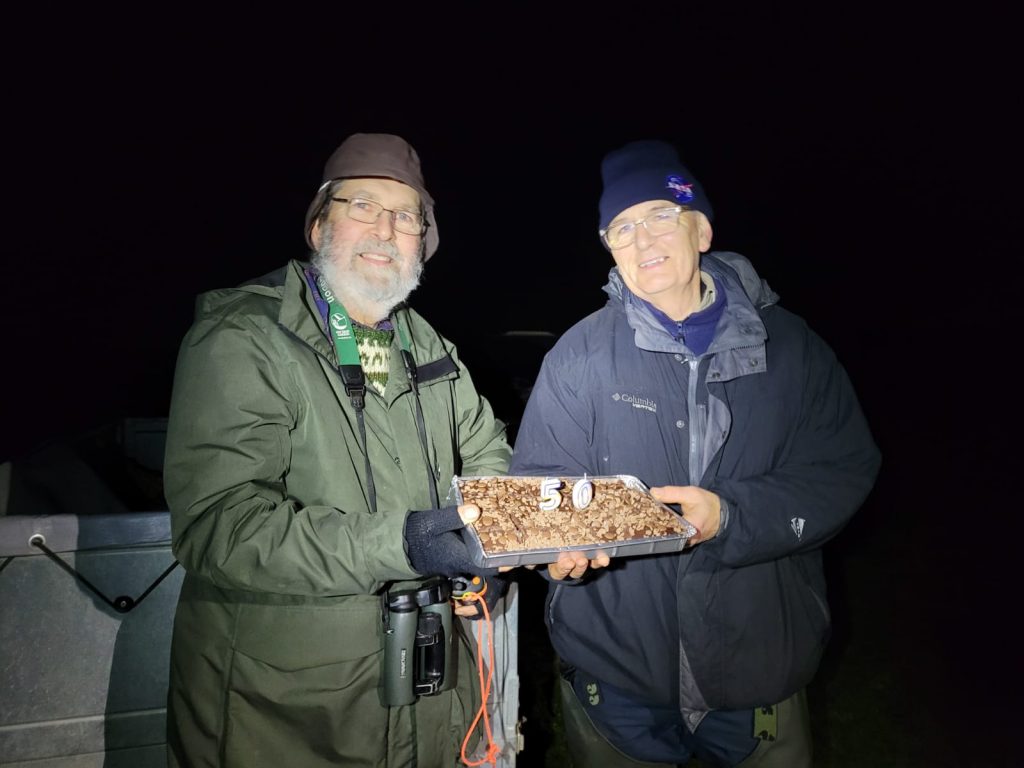
Once the lower, single net had been retrieved and the trailer was packed, we had a celebratory slice of cake to commemorate 50 years since Nigel and Tim started with the WWRG. The actual 50th anniversary was back in September 2025, but there hadn’t been enough time on intervening WWRG weekends to celebrate. Nigel and Tim have played an integral role in WWRG over those 50 years, and their outstanding contributions are too numerous to mention. A big thank you from everyone who’s volunteered with WWRG for all their help over the years!
With all the cake scoffed, we got Nigel’s car jump-started, and everyone made their way back for some food. After a splendid curry prepared by Cathy, Harriet and Nick, a debrief from Ros on the evening’s events, and plans made for a second catching attempt the next morning at Heacham South with the remaining two cannon nets that had been set, people made their way to bed.
Sunday 7 December
Ros, Molly and Claudia had a disturbingly early start on the Sunday morning, leaving at 03:15 hrs. This was to ensure they got to Heacham South in time to make some final alterations to the cables and jigglers, put equipment (covering material, holding boxes etc.) at basecamp, and get into position on the beach, thus minimising any disturbance on the beach before the birds arrived. Ros and Molly were at the firing position, and Claudia was one of the long stops (and an emergency twinkler if the birds flew south).
Two of the firing boxes unfortunately were not working properly during the tests (one later came back to life), so an additional firing box needed to be brought and dropped off at the firing position. With the trusty old wooden firing box in hand, the rest of the team left at 05:30 hrs. Once they’d arrived, Bill dropped off the wooden firing box and was later positioned as a northern long stop, whilst the rest of team quietly positioned themselves at basecamp in the dunes behind the two cannon nets. Isla and Christine were busy that morning looking for Knot roosts to collect some faecal samples, therefore were unable to attend the catch.
The thermal imagers were the only way of monitoring the movement of the flock up the shore, despite the bright moon. Hand warmers were placed out as markers but weren’t as visible with the thermal imagers as had been expected. This was perhaps due to the temperature difference between ambient and the birds being greater than that between ambient and the hand warmers. They did, however, allow for hares and muntjac around the net to be viewed during the dark, which is something that wouldn’t have been noticed previously; however, it would have been difficult to make a catch using the thermal imagers alone as it was difficult to assess the potential catch and the markers were not visible.
The tide had risen faster than expected, meaning that the birds were in position a lot sooner than expected (indeed, this was before basecamp were fully in position with two additional members joining from home). Therefore, the decision was made to wait until after high tide, with the hope that the birds would move back down the shore until they were in a catchable position. This also had the added benefit of allowing for it to get lighter, providing a clearer view of the birds present.
With the rising tide, the mix was estimated to be between 300 and 500 Curlew, Bar-tailed Godwit and Oystercatcher. However, as time went by and the tide turned, some of the birds in the flock started to leave to go and feed further inland. There were concerns that the entire flock would eventually leave; however, this proved to be an advantage, as the flock eventually shrank to a catch size of approximately 100 birds, with those remaining birds eventually moving far enough down the shore to allow us to fire. We thought to wait a little longer so that the tide receded a bit further, so that it would not be too wet a catch; however, Claudia had spotted a harrier flying northwards, so Ros took the decision to fire before the birds were spooked by the harrier. The net was fired at 08:06 hrs.
This proved to be the right decision, with a catch of 82 birds consisting of Curlew, Bar-tailed Godwit and Oystercatchers. As this was a small-mesh net, the most experienced members of the team were assigned to the corners of the net, whilst everyone else made their way along the front of the net, created a tent-like structure with the net, and walked the birds up the shore onto the dry shingle. Once the birds were under covering material, they were extracted and placed into their respective keeping cages, providing ample opportunity for new attendees to gain experience in extracting large waders from the net.
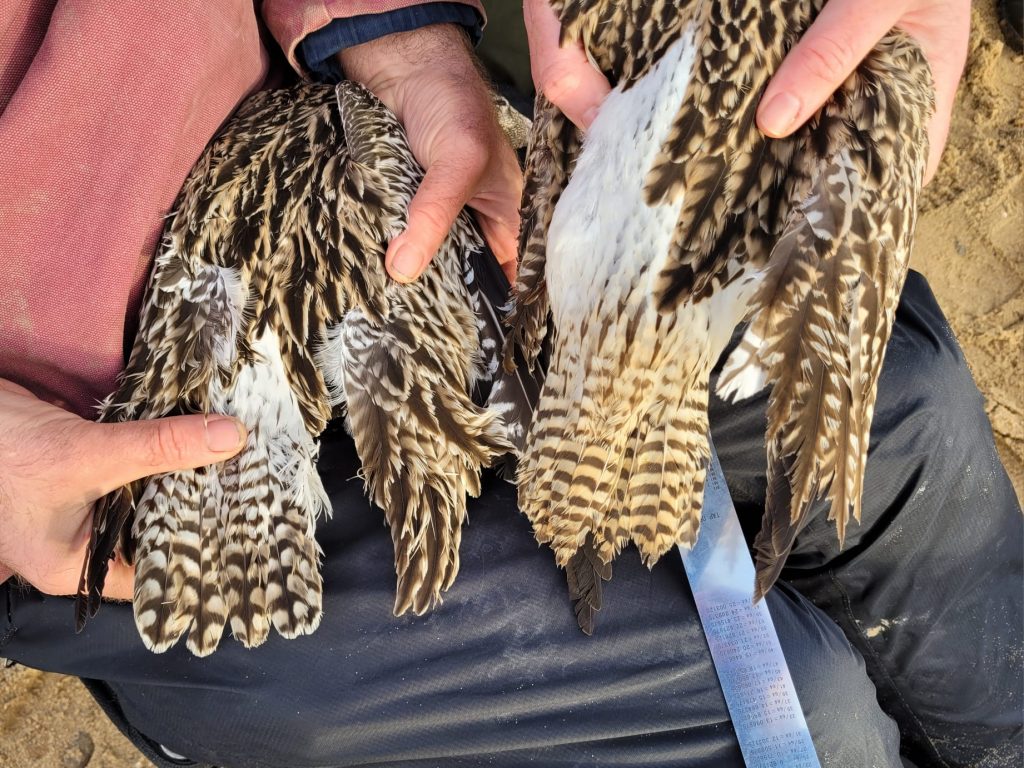
Once all the birds were in the keeping cages, everyone was split into various teams. Ros, Alastair and Michele led the metal-ringing team (Bill, Harriet and Bleddyn); Claudia and Molly led on colour ringing; and Rob, Nick and Cathy managed the processing of the birds post colour ringing. The number of birds caught provided a brilliant sample size. Indeed, Nigel believed this to be the largest Curlew catch that has been made on The Wash between November and March, and more than doubles the total caught in December. Yet, there was ample opportunity from this catch to train the new members, for example on how Curlew were aged at this time of year.
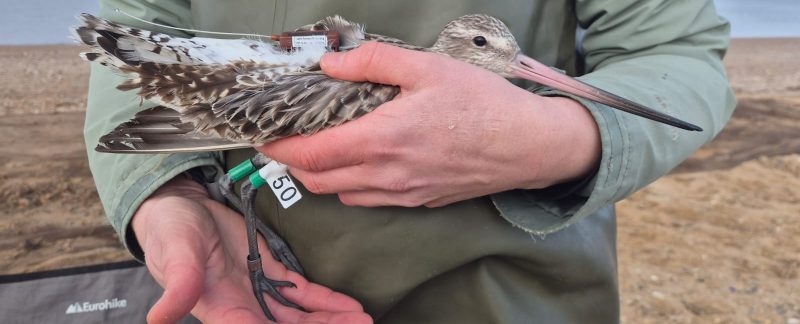
Katharine had joined the catch earlier in the morning with the aim of tagging Bar-tailed Godwit with GPS tags in order to monitor both their winter and migratory movements. Katharine has the appropriate BTO Special Methods permissions to attach GPS tags to Bar-tailed Godwit using a harness. Therefore, Katharine, with help from Mark, ringed and processed the four Bar-tailed Godwit that were caught and tagged the largest one.
Once all of the birds had been ringed and processed, the equipment was packed back into the trailer and everyone made their way back to the base house. Despite not attending the catch, Isla and Christine had prepared breakfast for everyone once they arrived – a much-appreciated gesture! Following a catch debrief, everybody helped pack and tidy the catching equipment, clean the house, and then made their way home after a highly enjoyable and successful weekend of wader work!
Summary of the resightings made during the weekend 5–7 December 2025.
| Species | Total sightings | Individuals identified |
| Curlew | 11 | 11 |
| Bar-Tailed Godwit | 4 | 4 |
| Turnstone | 17 | 13 |
| Total | 32 | 28 |
Catch totals at Heacham South on 7th December 2025.
| Species | New | Retraps | Total |
| Curlew | 31 | 19 | 50 |
| Oystercatcher | 15 | 13 | 28 |
| Bar-tailed Godwit | 3 | 1 | 4 |
| Total | 49 | 33 | 82 |
Thanks to Bleddyn Thomas for writing this report. Cover image by Katharine Bowgen.