Fieldwork August 2021

Saturday 21 August

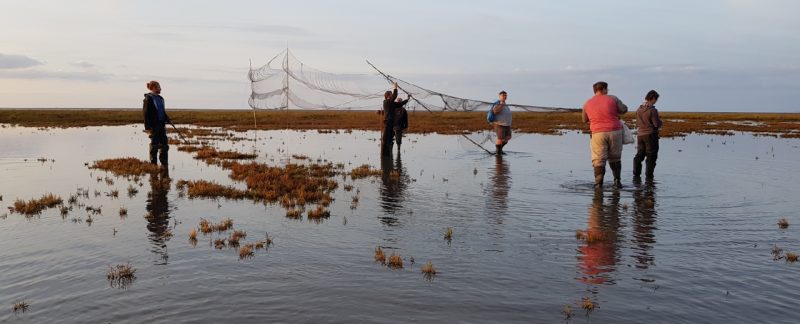
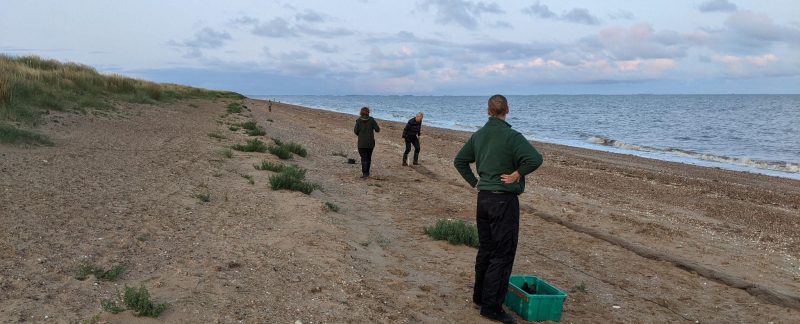
The team started to arrive around midday with Cathy being the first with Katharine soon after (to claim the best tent spots), soon followed by Nigel, Jacquie, Sam and Skye. Once tents were up and rooms claimed, the first action was to get the ‘party tent’ up outside on the patio. The marquee had been borrowed to allow for an extra covered space outside and it neatly fitted in the gap between the buildings. A little later Barrie, Ian, Rob and Kirsty arrived for lunch and initial plans for the week started to be made, beginning with recces in the afternoon at several sites to get the lay of the land wader-wise. Sam and Ian went to Snettisham, Katharine and Barrie to Ken Hill, Kirsty and Nigel to Gedney and Rob and Jacquie to Heacham North North.

Continue Reading →

Wash wader research on Autumnwatch

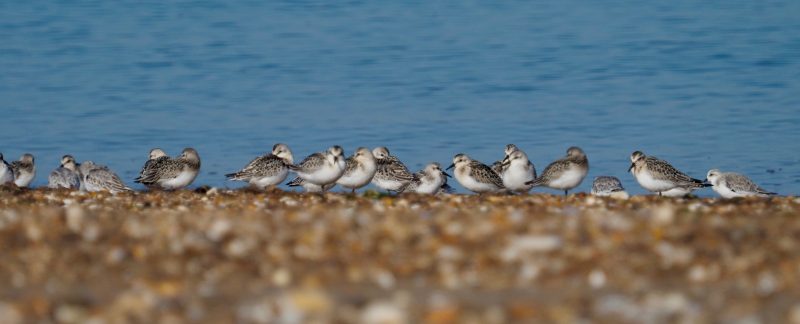
Normally when people hear what time we get up to set and man our nets they look rather bemused and think of their warm beds. So it was great to welcome a crew from Autumnwatch, who joined us in during our October 2021 fieldwork to find out about our research on waders using The Wash. The crew came out with us early on a beautiful sunny Saturday morning when our target was Sanderling, one of our 11 study species, which we were able to catch.

Continue Reading →

Using data to make a difference

Birth, and copulation, and death.
That’s all the facts when you come to brass tacks:
Birth, and copulation, and death.
I’ve been born, and once is enough.

Although not involved in bird study, these lines from T. S. Eliot encapsulate our current studies of wader populations on The Wash. Bird populations are sustained by recruitment of fledged young into the adult population at an equal rate to the death of individual adults. More recruitment than deaths equals more birds. Unfortunately, the opposite is currently occurring in Eurasian Curlew, which is experiencing population decline. This could be due to not enough chicks being raised to adulthood from each nesting attempt, or alternatively, it could be due to increased death of adult birds. Knowing which factor is more important allows conservation efforts to be prioritised: do we need to protect Curlew nests to improve chick survival or do we need to enhance protection of wintering Curlew to improve adult survival? A recently published paper has explored one part of the equation – survival in Curlew – using data from The Wash, as well as other wader ringers around Britain and Ireland.

Continue Reading →

Fieldwork February 2020

Weather forecast:

Storm Dennis!
Saturday – strong winds with showers
Sunday – strong winds with rain

Recce and plan for the weekend

The plan for the weekend was for a cannon-net catch on either Saturday or Sunday morning depending on the findings of the recce team on Friday morning. One of the aims for the weekend was a trial for catching waders on a non-spring tide – the tide heights were considerably lower than those for a normal catching weekend. Mist netting was not an option for the weekend due to the tide heights.

Continue Reading →

Fieldwork January 2020

Weather forecast

Saturday – strong winds
Sunday – less wind with rain

Recce and plan for the weekend

The original plan for the weekend, based on the timings for high tide and sunrise, was resighting on Saturday morning, mist netting on Saturday evening and a cannon net attempt on Sunday morning. However, the weather forecast soon made it clear that mist netting was not going to be an option for Saturday evening so a second plan was made which included a cannon net attempt on the rising tide on Saturday afternoon.

Continue Reading →